








How To Actually Make Money In China’s Emerging Superyacht Market
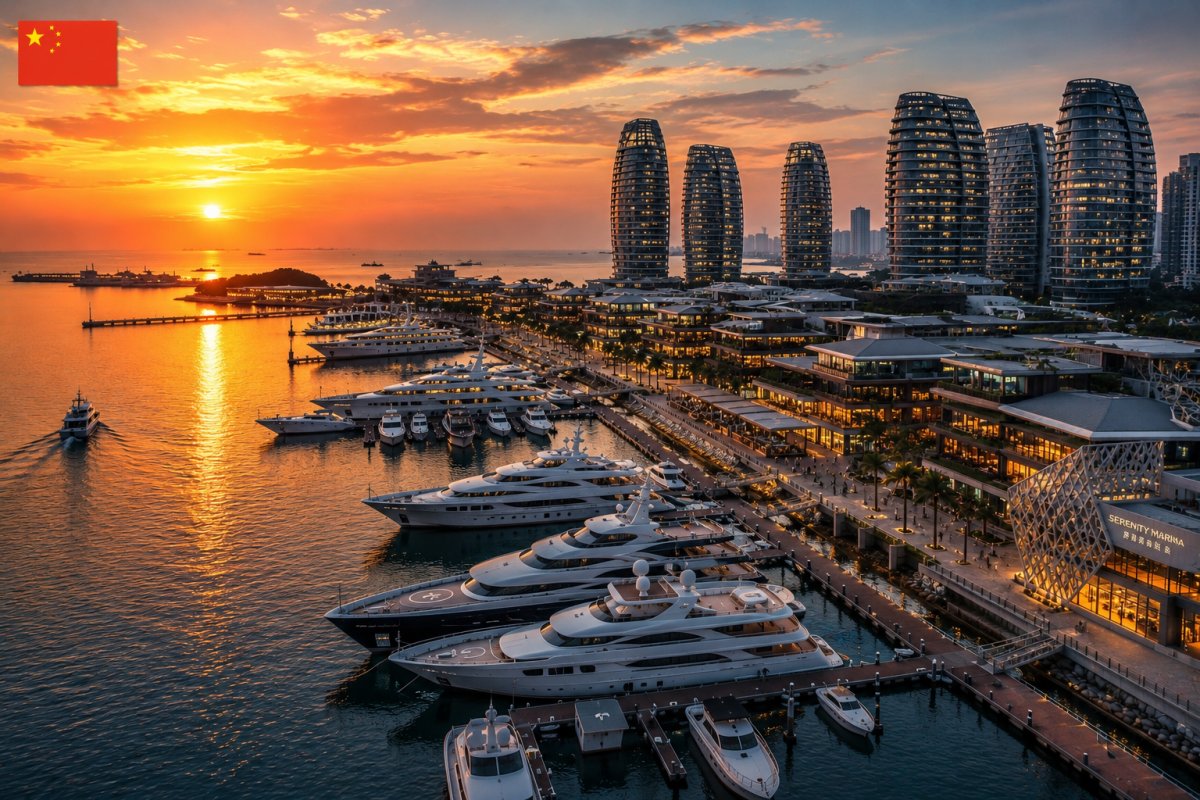
China’s Yacht Market Is Smaller Than Most People Think — But Far More Strategic
For years, the global yacht industry treated China as the inevitable next frontier for superyacht growth. The assumption appeared logical: rapid wealth creation, expanding coastal cities, and a rising ultra-high-net-worth population would eventually produce a market comparable to Florida, the Mediterranean, or the Gulf region.
That prediction only partially materialized.
China’s superyacht market remains relatively small compared to established Western hubs. Marina infrastructure developed slowly, regulatory frameworks remained restrictive, and private yacht ownership never became deeply embedded in everyday luxury culture. Yet beneath those limitations, something far more commercially interesting has started to emerge.
China is not evolving into a copy of the American yacht market. Instead, it is gradually developing its own version of marine luxury — one built around hospitality, social prestige, experiential consumption, tourism, and strategic waterfront infrastructure.
For brokers, yacht builders, marina operators, and marine investors, this distinction changes the entire business model.
The real long-term opportunity in China may not be selling the largest number of yachts. The real opportunity may lie in building the infrastructure surrounding marine luxury itself. This directly reflects GlobalBoats’ broader market-intelligence focus on identifying where marine demand, infrastructure, and commercial momentum are structurally moving.
Why China Is Fundamentally Different From The U.S. Yacht Market
One of the most common strategic mistakes in the global marine industry is assuming China will eventually behave like the United States.
The American boating market developed over decades through recreational boating culture, fishing communities, family ownership patterns, marina lifestyles, and coastal leisure traditions. Yacht ownership became deeply integrated into personal lifestyle identity.
China developed differently.
In many Chinese coastal markets, yachts are still perceived less as private recreational assets and more as high-end business environments, hospitality venues, status symbols, and luxury experience platforms. Ownership itself is often secondary to the social and commercial function surrounding the vessel.
This distinction matters because it changes where money is generated.
In mature Western yacht markets, value creation is heavily connected to ownership cycles, brokerage turnover, upgrades, maintenance, and resale activity. In China, future profitability may increasingly center around premium charter operations, marina real estate, luxury tourism, waterfront hospitality ecosystems, and integrated lifestyle infrastructure.
The yacht itself becomes only one component inside a much larger luxury-economic system.
The companies that recognize this early are likely to hold a significant advantage over competitors still applying purely Western assumptions to the Chinese market.
Hainan Is Emerging As China’s Marine Luxury Test Zone
The most strategically important region in China’s marine future may be Hainan.
China has spent years positioning Hainan as a free-trade and international tourism hub with gradually increasing regulatory flexibility. That development has enormous implications for the yacht industry because many of China’s historical marine limitations were directly tied to customs complexity, taxation, operational restrictions, and import barriers.
Hainan creates an environment where policymakers can experiment with marine tourism liberalization, foreign yacht access, marina expansion, charter models, and high-end hospitality integration without immediately applying those frameworks nationwide.
For the superyacht industry, this matters far beyond vessel sales.
The long-term commercial upside may emerge through marina infrastructure, waterfront real estate development, charter ecosystems, marine hospitality services, luxury tourism partnerships, and integrated lifestyle districts designed around affluent coastal consumption.
In many respects, the strategic direction increasingly resembles aspects of the Gulf marine model rather than the traditional Mediterranean ownership structure. The center of gravity shifts away from pure ownership and toward prestige-driven marine ecosystems.
Charter Economics May Outperform Ownership Economics
One of the most commercially important developments in China is likely to be the expansion of premium charter demand.
This is strategically significant because charter markets scale differently from ownership markets. Traditional ownership growth is constrained by marina capacity, taxation, regulation, operational friction, and maintenance costs. Charter demand, by contrast, scales through tourism, recurring customer experiences, corporate entertainment, and luxury hospitality consumption.
Younger affluent Chinese consumers are increasingly prioritizing flexibility, access, premium experiences, and social lifestyle signaling over long-term ownership commitments. Similar behavioral shifts already transformed sectors such as luxury automotive access, private aviation, luxury travel, and premium hospitality.
The marine industry is likely to follow the same pattern.
For brokers and operators, this creates a far more recurring and service-oriented revenue model. Future profits may increasingly originate from yacht management, concierge services, charter operations, luxury memberships, event partnerships, destination experiences, and curated marine lifestyle offerings rather than solely from one-time vessel transactions.
That transition could fundamentally reshape how marine companies position themselves inside China over the next decade.
The Largest Opportunity May Be Infrastructure, Not Boats
Most public discussion around the superyacht sector focuses on vessels themselves.
But emerging marine economies are rarely built through boats alone. They are built through infrastructure.
China still faces substantial structural gaps in premium marina capacity, large-yacht berthing, marine servicing, refit capability, crew support infrastructure, and integrated coastal luxury ecosystems. Those gaps represent long-term commercial opportunity.
This creates space for companies involved in marina technology, floating infrastructure systems, yacht logistics, marine security, refit operations, fueling networks, and smart waterfront developments. The surrounding ecosystem may ultimately become more scalable and profitable than the vessels themselves.
This pattern already became visible in Dubai, Singapore, Miami, and parts of Southeast Asia, where marina-centered luxury districts evolved into powerful economic ecosystems extending far beyond boating alone.
China may gradually follow a comparable trajectory — but adapted to Chinese consumer behavior, state-managed development priorities, and regional tourism strategies.
Western Yacht Builders Still Hold A Powerful Advantage
Despite China’s industrial scale and manufacturing capabilities, Western yacht brands still possess an enormous strategic advantage in the ultra-premium segment.
Prestige in the superyacht world remains heavily connected to heritage, craftsmanship, trust, design language, and international reputation. Italian, Dutch, British, and German builders continue to dominate perceptions of elite marine luxury among many ultra-high-net-worth buyers globally.
That gives Western brands a meaningful position inside China’s developing market.
But the advantage is not permanent.
Chinese luxury consumers are becoming younger, internationally connected, digitally sophisticated, and increasingly experienced with global premium markets. Expectations are rising quickly. Buyers increasingly understand international standards, service quality, customization, and long-term ownership economics.
The builders most likely to succeed in China are those capable of balancing global brand prestige with localized market understanding — without reducing their identity to generic luxury marketing.
Why The Next Ten Years Matter
China’s superyacht market will probably not experience an overnight explosion.
But the structural direction is becoming increasingly visible. Coastal wealth continues to expand. Luxury tourism is growing. Waterfront development is accelerating. Experiential consumption is rising. Marine lifestyle normalization is gradually increasing among younger affluent consumers.
Even moderate adoption inside China can create enormous economic impact because of the sheer scale of the country’s upper-income population.
The most important insight for the global marine industry is that the largest long-term winners may not be the companies selling the highest number of yachts today.
The winners may be the companies already building trusted positions inside the surrounding ecosystem — marina infrastructure, charter operations, hospitality integration, marine services, luxury waterfront environments, and premium regional market access.China is no longer simply a speculative future yacht market.
It is increasingly becoming a strategic marine infrastructure market.
That distinction may define where the next decade of marine industry growth actually happens.