








Why Americans Buy 50,000+ Pontoon Boats Every Year – And Why China Wants Them
Why Are Americans Obsessed with Pontoon Boats?
There are always things we don’t understand. I understand a speedboat — fast driving, pure fun. I understand a Sea Ray — sipping cocktails, cruising home quickly, good talks and swimming. I understand a center console boat with a tower for fishing. I understand converting an old trawler into a floating home that I can take offshore to the UK. All of that makes sense to me.
What I don’t understand is why the USA sells tens of thousands of new pontoon boats every year, and why these boats now make up roughly 25–30 % of the entire American powerboat market. What kind of trend is this? What am I supposed to do with a floating party platform?
Section 1: What the Heck is a Pontoon Boat?
Definition A pontoon boat is a flat-decked vessel that floats on two or more large, sealed cylindrical tubes (called pontoons). These tubes provide buoyancy, while the deck sits on top like a stable platform. Unlike traditional V-hull boats, pontoons are not designed for cutting through waves at high speed — they are built for calm or protected waters.
History The modern pontoon boat was invented in the 1950s in the United States. The idea was simple: take two or three aluminum or steel pontoons, put a flat deck on top, add an outboard motor — and you have a stable, spacious boat that’s easy and cheap to build. Early models were very basic — almost like floating rafts with benches. They were popular on lakes and rivers where rough seas were not an issue.
Development Over Time In the 1980s and 1990s, pontoons started to improve: better materials, more comfortable seating, and bigger engines. By the 2000s, they became much more luxurious. Today we see “tri-toons” (three pontoons) that can reach high speeds, luxury versions with leather seats, wet bars, powerful sound systems, underwater lights, and even water slides. What began as a simple “party barge” has evolved into a sophisticated leisure platform.
Where We Stand Today (2026) Pontoon boats are now one of the most popular boat types in America. They make up roughly 25–30 % of the new powerboat market. Modern pontoons range from simple family models for $30,000 to luxury versions costing $150,000+. They are stable, versatile, family-friendly, and easy to drive — perfect for lakes, rivers, and calm coastal waters.
Section2: Why is there such a huge Pontoon Boom in the USA?
The pontoon boom has several clear reasons. Americans love pontoons because they are extremely practical, social, and family-friendly. Unlike fast speedboats or expensive offshore boats, pontoons feel like a floating living room. You can sit comfortably, grill, play music, let the kids swim safely, and spend relaxed time with the whole family or friends. They are stable, offer lots of space, and work perfectly on most American lakes and rivers.
Another big driver is the price-performance ratio. A decent entry-level pontoon is more affordable than many sport boats and needs less maintenance. At the same time, you can upgrade them heavily — from basic models to fast tri-toons with powerful engines.
And yes — a lot of people are literally welding their own pontoon boats together in their backyard or garage. If you can hold a welding torch and have a bit of space, you build two aluminum tubes, put a deck on top, add a motor, and you have your boat. This DIY culture also fuels the boom.
In short: The huge success comes from the fact that pontoons are exactly what many Americans want for weekend fun on the water — relaxed, social, versatile, and not too complicated.
Section 3: Pros and Cons – With Real Numbers & Data
Here’s a fact-based look at why pontoons are booming — and where they fall short:
Pros (The Strengths Backed by Data)
- Stability & Capacity: Most pontoons can comfortably carry 10 to 16 people, far more than a similar-sized speedboat. Their wide design gives them excellent stability — ideal for families.
- Market Dominance: They represent 20–30 % of new powerboat sales in the US, showing strong consumer preference.
- Versatility & Usage: According to industry surveys, pontoon owners use their boats more frequently than owners of many other types — often for casual cruising, entertaining, and light fishing.
- Value Retention: Well-maintained pontoons hold their value reasonably well on the used market, especially popular brands and tri-toons.
- Growth: The pontoon segment has shown more resilience than speedboats or wake boats in recent slower sales years.
Cons (The Limitations with Context)
- Rough Water Performance: Pontoons are designed for calm to moderate conditions. In waves over 2–3 feet they can become uncomfortable and wet — a reason why they are far less popular in coastal Europe.
- Speed: Basic twin-toon models typically top out at 20–30 mph. Only higher-end tri-toons with big engines regularly reach 40–55+ mph.
- Aesthetics & Perception: Many boating enthusiasts still see them as “party barges.” This image persists despite luxury models costing over $150,000.
- Wind Sensitivity: Due to their high sides and flat profile, they catch a lot of wind, making docking and maneuvering in strong crosswinds more challenging.
Bottom Line with Numbers: Pontoons win on space, stability, and social use (hence their 25–30 % market share), but they lose on rough water capability and sporty performance. They are the perfect tool for millions of Americans who want relaxed fun on protected waters — but not everyone’s idea of a “real boat.”
Section 4: Is the Pontoon Boom a Long-Term Sustainable Trend?
Yes, the pontoon boom is not a short-term hype — it is a structural, long-term trend.
Key Facts & Numbers:
- Pontoons have maintained a 20–30 % share of the U.S. new powerboat market for several years.
- Annual new sales typically range between 45,000 and 65,000 units.
- The global pontoon market is valued at around USD 8.5 billion (2024/2025) and is growing at 7–8 % CAGR.
- Demand is supported by strong demographic drivers: Baby Boomers, families, and recreational users who prefer calm-water, social boating.
These numbers have been remarkably consistent even during economic slowdowns, proving that pontoons are deeply rooted in American boating culture.
Transition to the Future While the long-term outlook for the pontoon segment remains positive, the industry is facing a new challenge that could change the game dramatically.
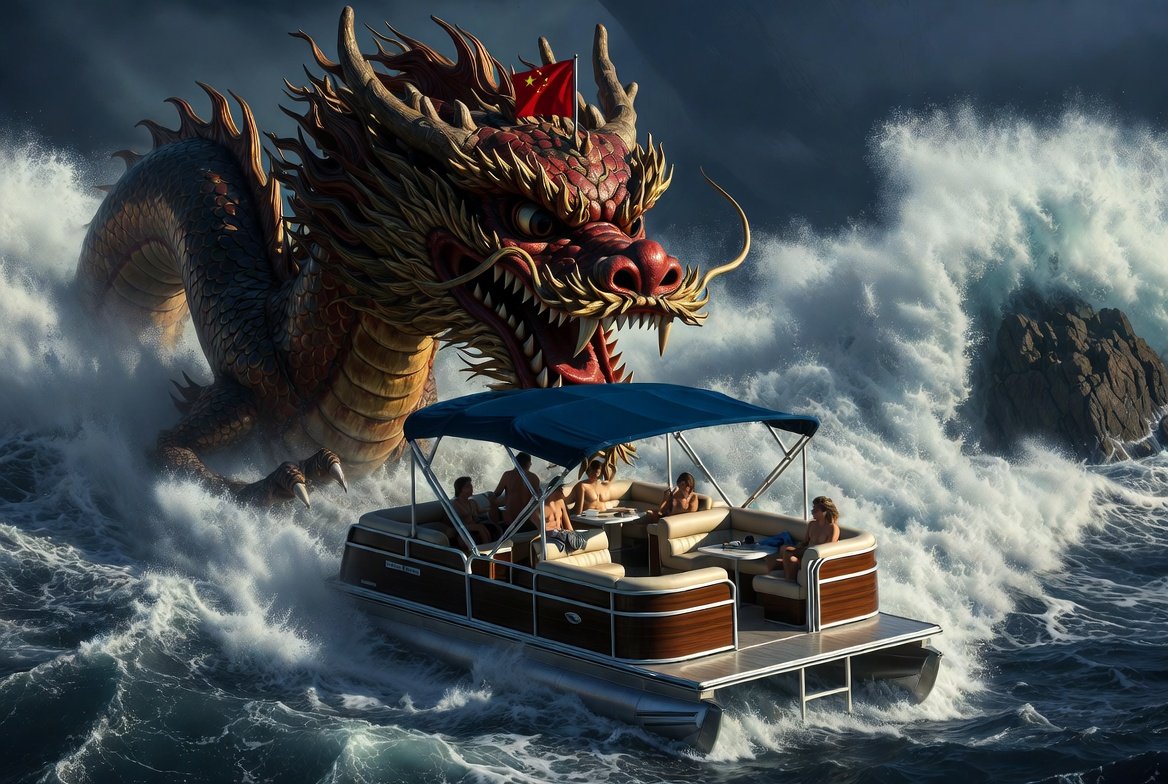
Section 5 The Chinese Tiger – Is It Showing Its Claws?
While the pontoon boom looks sustainable, a new threat is quietly growing in the background: Chinese manufacturers.
China already dominates many aluminum and marine-related industries. Producing pontoon boats is relatively straightforward — two or three aluminum tubes, a deck, some seating, and an outboard motor. This plays perfectly into China’s strengths: low production costs, fast scaling, and strong supply chains for aluminum and components.
What we are already seeing:
- Several Chinese brands and OEM manufacturers are starting to export pontoons to the US and other markets at significantly lower prices than American or European builders.
- Some US dealers are already quietly importing or private-labeling cheaper Chinese-built pontoons.
- If Chinese producers manage to combine acceptable quality with 30–50 % lower prices, they could flood the entry-level and mid-range segments very quickly.
For Western producers this means:
- Strong pressure on margins in the lower price classes.
- The need to move upmarket (luxury, high-performance tri-toons, premium features, better service and branding).
- The risk that “dumb” basic pontoons become a commodity product dominated by low-cost Asian production.
Conclusion of this section: The Chinese tiger is not yet fully in the pontoon arena — but it is circling. The next 5–10 years will show whether American and European manufacturers can defend their home market through quality, innovation, and brand power, or whether cheap Chinese pontoons will take a big bite out of the boom.
Section 6: Summary – The Chinese Threat
The pontoon boom is real and likely sustainable in the long term due to strong American demand for comfortable, social, and family-friendly boating. However, this success is attracting serious competition.
Chinese manufacturers are increasingly entering the market with much lower production costs. Because pontoon boats are relatively simple to build, they are a perfect target for low-cost, high-volume Asian production. If Chinese builders manage to deliver acceptable quality at 30–50 % lower prices, they could rapidly take over large parts of the entry-level and mid-range segments.
For American and European producers, this means the easy-growth phase is ending. Success in the future will depend on moving upmarket, focusing on quality, performance, luxury features, and strong branding — rather than competing on price alone.
The Chinese tiger is starting to show its claws in the pontoon market. The coming years will decide who wins the next phase of this boom.
Overall Conclusion & Final Summary
The pontoon boat phenomenon is one of the most interesting trends in the American recreational boating market. What started as simple “floating platforms” has grown into a major industry segment that now represents 20–30 % of new powerboat sales in the USA, with annual volumes of 45,000–65,000 units and a global market value of around USD 8.5 billion.
Final Takeaways
For US Dealers & Brokers: Focus heavily on pontoons. They sell well to first-time buyers, families, and older customers. They offer good margins on accessories, are easier to finance, and have strong used-market demand. Build expertise in this segment — it will be one of your most reliable revenue streams in the coming years.
For US Producers / Manufacturers: The golden years of easy growth are not over, but they are changing. You can still make good money, but only if you differentiate. Invest in quality, performance (especially tri-toons), luxury features, innovative designs, and strong customer service. Avoid competing directly with low-cost Chinese production in the basic segment.
For Everyone: The Chinese tiger is waking up. Chinese manufacturers will increasingly push into the pontoon market with cheaper boats. The winners of the next decade will be those who understand that pontoons are no longer just simple party barges — they are becoming lifestyle platforms.
Final Word: Pontoons are not a fashion trend. They are a logical response to what many Americans actually want from boating: fun, comfort, and social time on the water. As long as that desire stays strong, the pontoon segment will remain healthy — but only the smart players who adapt will continue to profit from it.