
2026: How the 15th-Century Trade Winds and “Volta do Mar” Created the World’s First Global Trading Empire
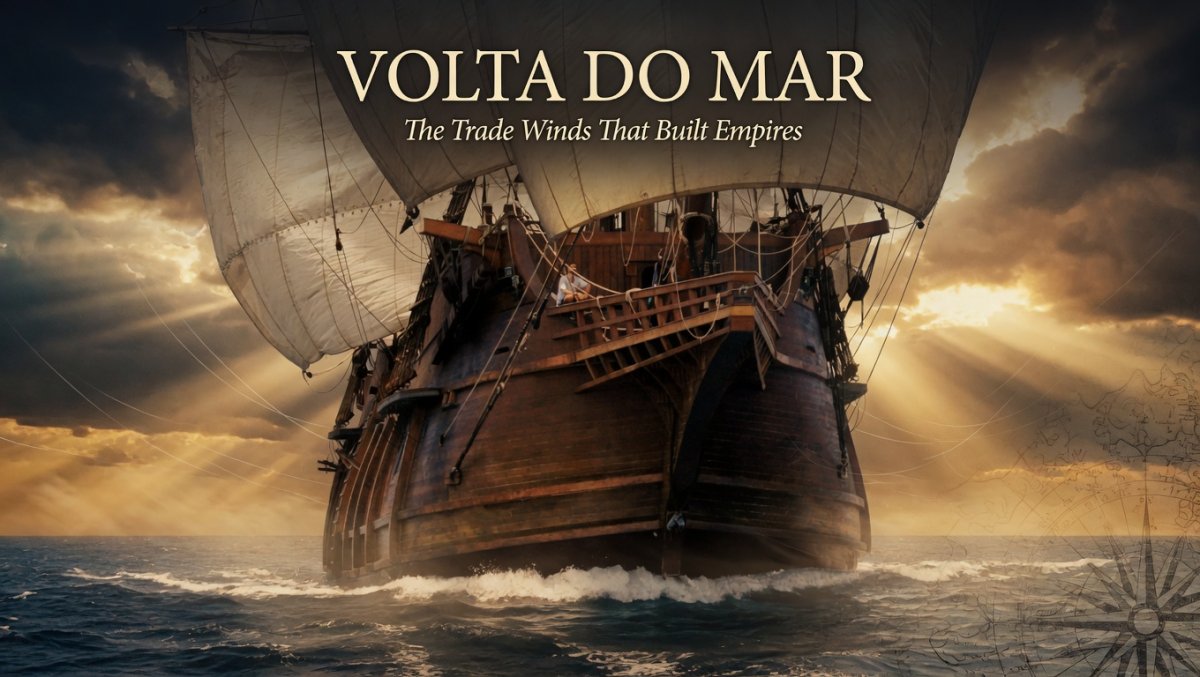
In the late 15th century, a small country with fewer than 1.5 million people on the edge of Europe did something extraordinary. Portugal, using nothing more than sailing ships, reliable wind patterns, and one brilliant navigation strategy called Volta do Mar, built the first truly global maritime trading empire. This system turned predictable Trade Winds into a profit machine that generated returns modern hedge funds would envy.
The Trade Winds: Nature’s Reliable Trading Engine
The Trade Winds are permanent east-to-west prevailing winds created by the Earth’s rotation and solar heating near the equator. In the Northern Hemisphere they blow from the northeast, in the Southern Hemisphere from the southeast. Average speeds range between 10–20 knots, making them ideal for long-distance sailing.
These winds form part of massive ocean gyres. The Portuguese mastered the North Atlantic Gyre — a clockwise wind and current system. By understanding this pattern, they transformed risky coastal hugging into efficient blue-water sailing.
What Exactly Was “Volta do Mar”?
“Volta do Mar” literally means “turn of the sea” or “return from the sea.” It was a counter-intuitive sailing technique perfected by Portuguese navigators around the 1440s–1480s under Prince Henry the Navigator and his successors.
The classic maneuver worked like this:
- Outbound leg: Sail south along the African coast using the Canary Current and Northeast Trade Winds (down to the Gulf of Guinea or further).
- Return leg: Instead of fighting headwinds back north along the coast, ships sailed far west into the open Atlantic (sometimes hundreds of miles), then curved north and northeast to catch the prevailing Westerlies near the Azores (around 35–40°N latitude). These westerlies carried them straight back to Portugal.
This “big loop” often added distance but dramatically reduced time and risk. A direct coastal return could take months of beating against the wind. The Volta do Mar made the round trip reliable and repeatable.
For the route to India, navigators later developed an even larger South Atlantic Volta: after crossing the equator, they swung far west toward the coast of Brazil before turning east to round the Cape of Good Hope. This maneuver was used by Bartolomeu Dias (1488) and Vasco da Gama (1497–1499).
Hard Numbers: The Economic Impact
The results were staggering:
- Vasco da Gama’s 1497–1499 voyage to India returned with cargo worth 60 times the cost of the expedition.
- In the early 16th century, Portugal controlled the European spice trade. One quintal (≈100 kg) of pepper bought in India for about 6 cruzados could be sold in Lisbon for 20+ cruzados — a gross margin exceeding 200% before costs. Net profit after transport and protection often reached 90%.
- By the mid-16th century, customs duties from the Asian trade alone accounted for up to 60% of total Portuguese crown revenue in some years.
- Between 1500 and 1580, Portuguese ships carried thousands of tons of spices annually. The crown maintained a near-monopoly on the Cape Route until the Dutch and English broke it in the early 17th century.
- In the Atlantic, Portugal transported roughly 150,000 African slaves to the Americas in the first quarter of the 17th century alone. By the late 16th century, nearly 10,000 slaves per year left Angola.
At its peak around 1580, the Portuguese Empire controlled trading posts and territories spanning from Brazil to Japan — covering more than 5.5 million square kilometers by the 19th century, one of the longest-lasting colonial empires in history (1415–1999).
The Producer, Trader & Broker Playbook of the 1500s
1. For Producers (Supply Chain & Logistics Masters) The Portuguese understood that distribution beats product quality in the early stages. They didn’t produce most of the spices — they controlled the route. They built a network of fortified factories (feitorias) from West Africa to Macau. This vertical integration of production pickup, protection, and delivery created an unbeatable supply chain.
2. For Traders (Risk & Edge Management) Every voyage was a highly leveraged macro bet on seasonal wind patterns, not daily price fluctuations. Captains studied latitude-based wind charts the way today’s traders study economic calendars. They avoided the “Doldrums” (the Intertropical Convergence Zone near the equator) — a windless area that could trap ships for weeks — by swinging wide into the Atlantic.
3. For Brokers & Intermediaries Portuguese captains acted as global brokers. They exchanged European silver, cloth, and horses for African gold and slaves, then Indian spices and Chinese silk. In 1506 alone, crown revenues from African and Asian trade were enormous relative to the country’s tiny GDP. The Casa da Índia in Lisbon functioned like a central clearing house for global commodities.
Lessons That Still Apply in 2026
- Understand macro patterns: Trade Winds haven’t changed in 500 years. Markets still have persistent “winds” — technological cycles, regulatory seasons, demographic shifts. The winners are those who position themselves to ride them instead of fighting them.
- Take the long route when necessary: The shortest path is often the most expensive. Sometimes you must sail “west to go east” — meaning accept short-term detours for long-term efficiency.
- Build resilient systems: Portugal’s edge came from repeatable processes (Volta do Mar) + infrastructure (forts, charts, caravel ships). Modern producers and traders need the same: reliable funnels, not one-hit wonders.
- Scale with asymmetry: A country of 1–2 million people dominated global trade for over a century because they leveraged natural forces (winds) and information asymmetry (superior navigation knowledge).
The Bottom Line
The Portuguese didn’t win because they had the biggest navy or the most capital initially. They won because they became the best wind readers on the planet. They turned invisible atmospheric patterns into visible wealth.
Today’s brokers staring at screens, traders managing portfolios, and producers building brands face the same fundamental choice the Portuguese captains faced in the 1480s:
Master the prevailing conditions and ride them — or exhaust yourself fighting against the wind.
The Trade Winds still blow. The question is whether you will build your strategy around them, or keep sailing straight into the headwinds.