








What If the USS Nimitz Replaced the USS Hornet and Powered an AI Data Center in Alameda?
Could the USS Nimitz (CVN-68) Become an AI Data Center After Leaving Naval Service? – Part II
In our first article, we explored whether the retired USS Nimitz could itself be converted into a massive AI data center. We concluded that while the idea is fascinating, the available internal space on the carrier would severely limit its potential as a full-scale compute facility.
Now we ask a more targeted follow-up question:
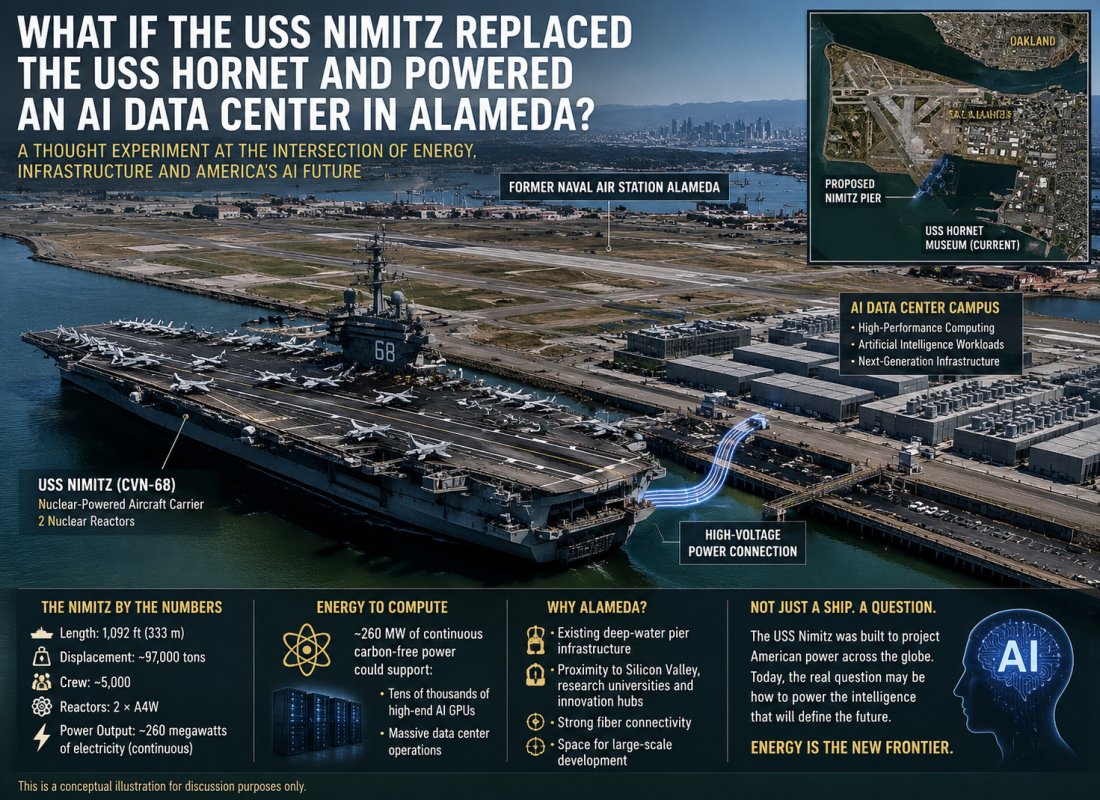
What if we solve the space problem entirely? What if we don’t use the Nimitz as the data center itself — but instead as a floating nuclear power plant docked near Alameda, delivering clean power to a large new AI facility built on the former Naval Air Station grounds?
Would this approach finally deliver a real advantage in the AI race?
----------------------------------------
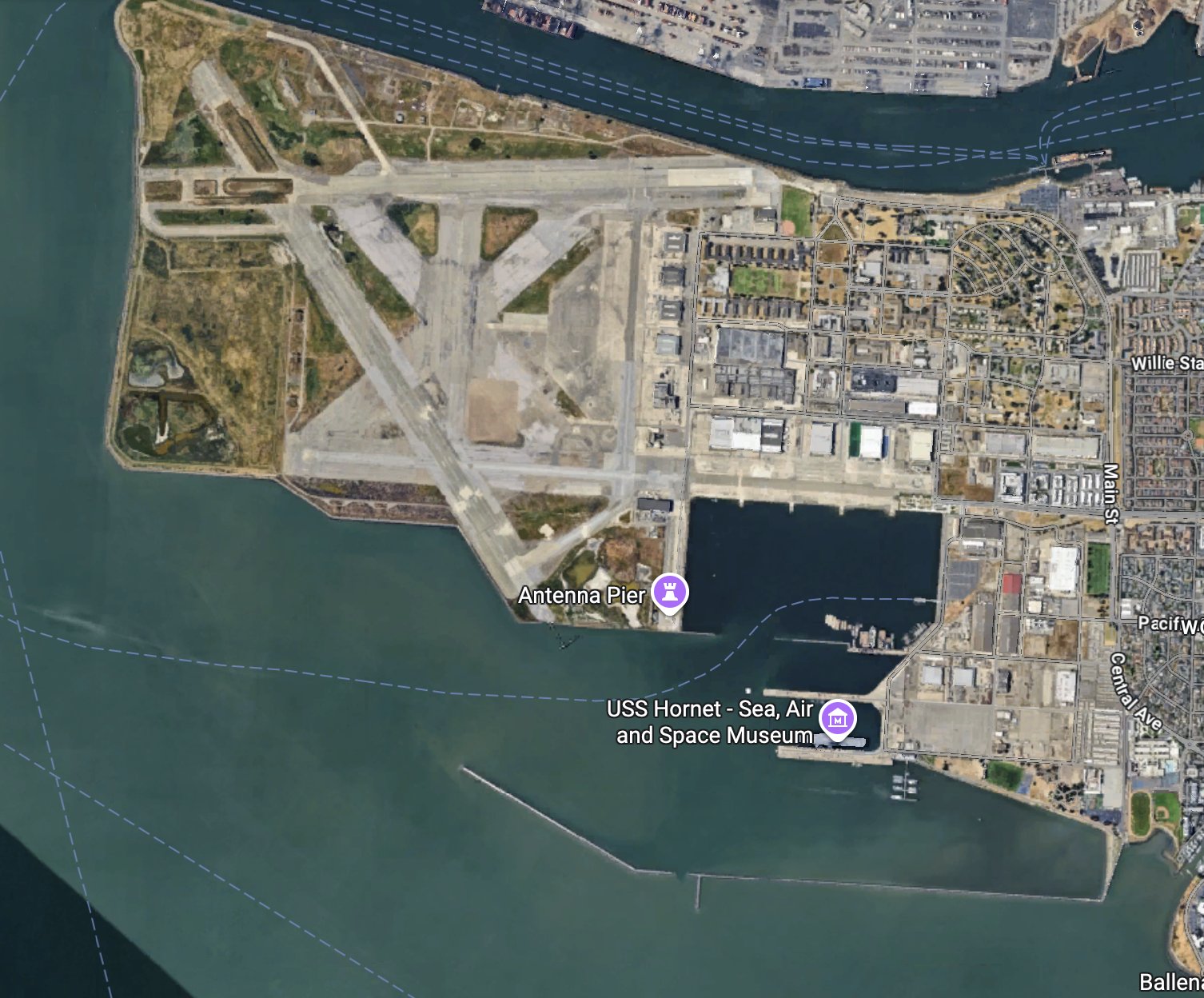
Lets see:
The AI race will not be decided solely by Cerebras, Nvidia, or the sheer size of Colossus. Of course the chips matter. Of course scale matters. But if you look closely, the real bottleneck is no longer primarily land or even hardware.
The real bottleneck is energy.
You can find enough flat land almost anywhere in the United States to build a data center quickly. What you cannot easily find is hundreds of megawatts of clean, reliable, and — most importantly — locally available power exactly where the users and developers are.
This brings us to an interesting idea.
The Dream Scenario
Ideally, we would have a nuclear power plant in the San Francisco Bay Area paired with a massive AI data center. Because that is where the highest concentration of AI talent, companies, and end users on the planet sits. Latency would be minimal. Iteration cycles between research and training would be lightning fast.
So what if we did something bold?
What if we moved the USS Hornet to Sausalito, docked the USS Nimitz right beside it as a floating interim power plant, ran a 2 km high-voltage cable across the water, and converted the former Alameda Naval Air Station into a gigantic AI data center?
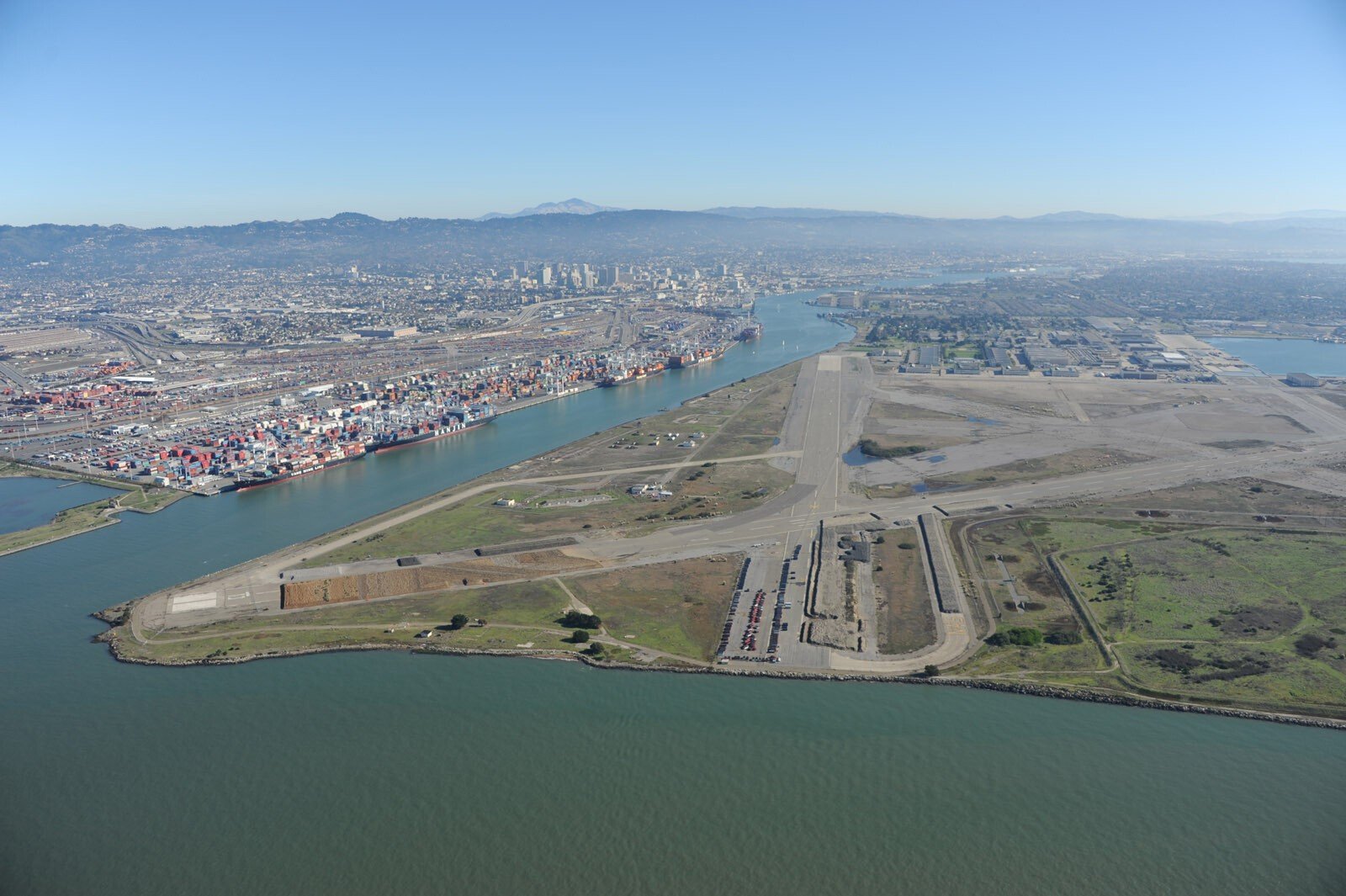
On paper, this would solve several problems at once:
- Massive nuclear power exactly where it is needed most
- A huge AI cluster close to the best engineers and researchers
- Reuse of existing military infrastructure
- A powerful symbolic statement
It sounds like a brilliant hack.
Our Technical Model
Let’s move beyond the romance and run the actual numbers.
The USS Nimitz is powered by two Westinghouse A4W pressurized water reactors with a combined thermal output of approximately 1,100 MWth. In normal propulsion mode, this produces around 194 MW of mechanical power.
For pure electricity generation (routing steam directly to generators instead of turbines for the propellers), the picture improves.
Conservative, safe, long-term continuous output: → 200 MW net delivered to shore
With a modern PUE of 1.15–1.18, this leaves roughly 168–172 MW of usable IT load for the servers.
Using current-generation Blackwell systems (GB200 NVL72 racks):
- 1,250 – 1,420 high-density racks
- 90,000 – 105,000 GPUs (B200 / GB200)
- Performance: well over 30 ExaFLOPS (FP8)
This would still rank among the top 10 largest AI training clusters in the world. Perfectly capable of training and fine-tuning frontier models, running massive inference farms, and accelerating the next generation of Grok.
The 2 km cable run from the pier to the Alameda Point site is technically straightforward. At 132 kV transmission voltage, losses would be under 0.4% — essentially negligible. Bay water cooling would further improve efficiency.
On paper, this looks strong.
The Sobering Reality
Despite the creativity, here is the honest assessment:
This project would not deliver a decisive compute advantage in the global AI race.
Here’s why:
- Scale While we fight hard to deliver 100,000 GPUs in Alameda, xAI is already scaling Colossus in Memphis toward 500,000–1,000,000 GPUs. Other labs (Meta, Google, Microsoft/OpenAI) are also thinking in gigawatt dimensions. 200 MW is respectable — but no longer leadership scale in 2026.
- Speed In Texas or Tennessee, you can stand up 100k GPUs in under five months. In the Bay Area, the permitting process alone (CEQA, BCDC, local authorities, environmental reviews, nuclear concerns) would likely take 18–36 months — if it gets approved at all. In the current pace of the AI race, that delay is deadly.
- Scalability The Nimitz can safely deliver 200–220 MW long-term. That’s it. Building new nuclear reactors in California remains extremely difficult politically and legally. After Phase 1 we would be back to depending on the California grid — which is expensive, unreliable, and heavily politicized.
- Talent vs. Raw Compute The Bay Area remains world-class for research, model architecture, and rapid iteration. But heavy pre-training of large models is primarily limited by cheap, reliable, abundant power. That resource is simply not available here at scale.
Final Verdict
The Nimitz + Hornet + Alameda concept is creative, symbolically powerful, and technically feasible as an interim solution. It would make for an incredible statement project and could serve as an excellent high-value development and inference hub close to talent.
But it does not solve the core constraint of the AI race:
We need gigawatts, not megawatts — delivered where energy is abundant and regulation supports rapid scaling.
The smartest approach is likely a two-site strategy:
- Alameda as a premium, talent-adjacent development and inference site (powered by the Nimitz for ~100k GPUs)
- A true large-scale Colossus hub (500 MW+) in a state that actively welcomes nuclear and data centers (Texas, Tennessee, etc.)
The AI race will not be won in the San Francisco Bay. But the Bay can still play a crucial role in shaping and accelerating it — as long as we are honest about where the real heavy lifting needs to happen.
----------------------
At the very moment Silicon Valley is scrambling for the power needed to fuel the AI revolution, one of the most powerful nuclear assets ever built remains in active service with the U.S. Navy. The USS Nimitz still sails the Pacific, carrying enough onboard energy to expose a much larger question: does the Bay Area have enough power to remain the global center of artificial intelligence?
See also: