








Could the USS Nimitz (CVN-68) Become an AI Data Center After Leaving Naval Service?
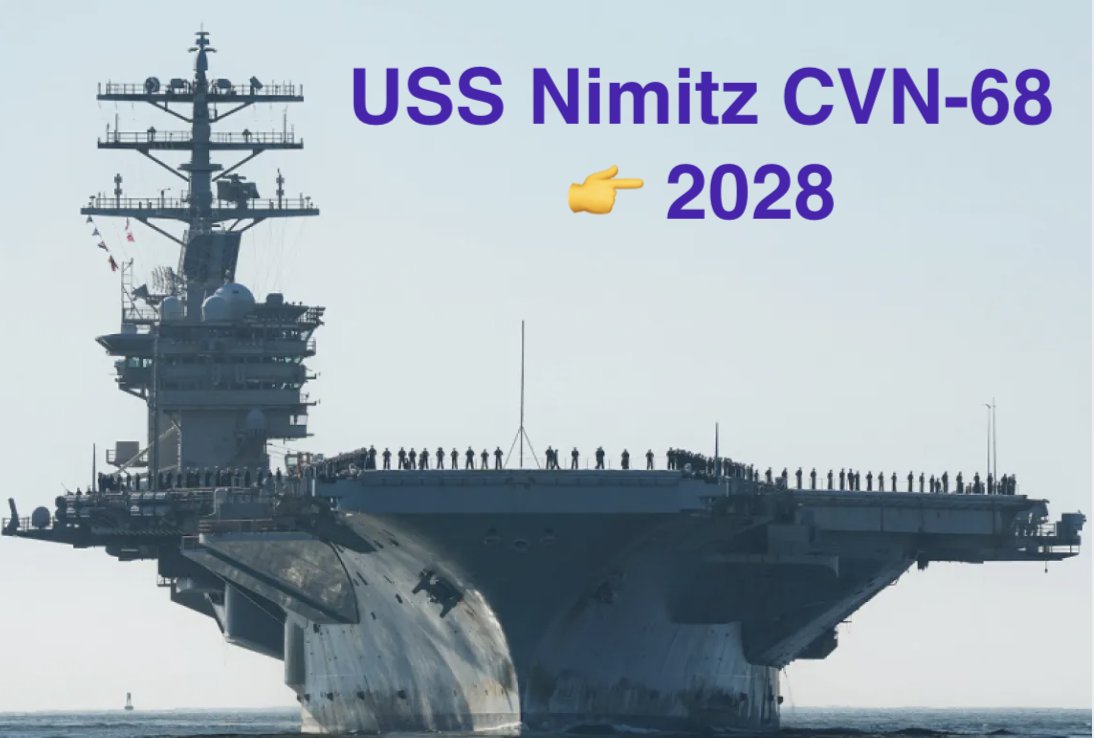
The USS Nimitz (CVN-68), affectionately known as “Old Salt,” is a piece of living American mythology. Commissioned in 1975 and now over 51 years old, she should have been decommissioned in 2025 or 2026. Instead, she remains active until at least March 2027 — a clear symptom of chronic delays with the Ford-class carriers and ongoing geopolitical pressures.
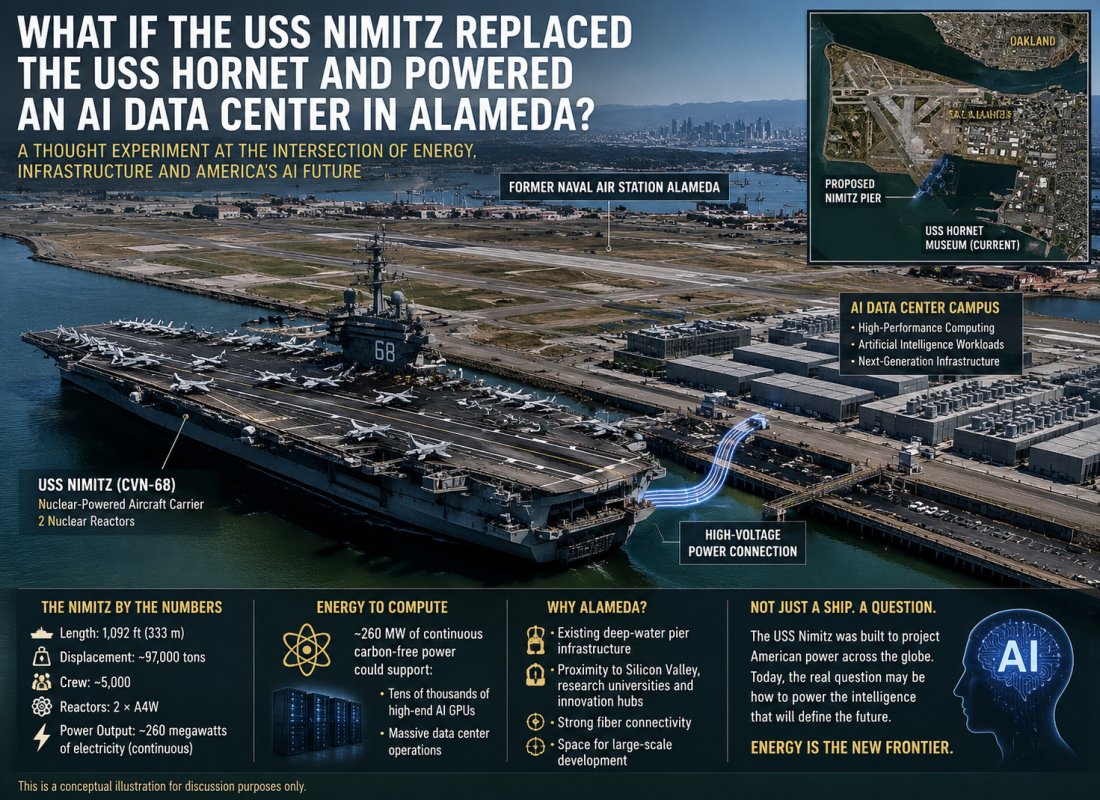
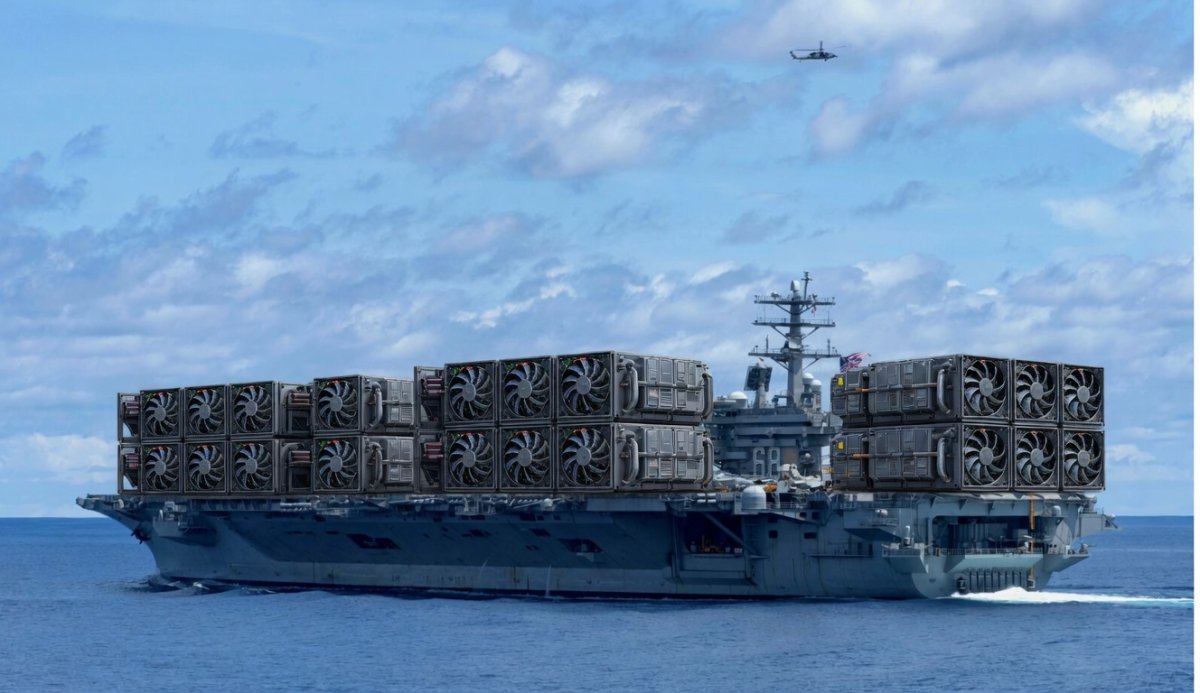
But what if we didn’t scrap this icon, but radically repurpose it? The idea: Transform the Nimitz into a floating AI data center — a true Colossus-on-Sea. With her nuclear power plant, enormous flight deck (approx. 18,000–20,000 m²) and hangar (approx. 6,800–7,100 m²), she appears at first glance perfectly suited for the energy and space challenges of the AI era.
Technical Foundations
Power: The two A4W reactors of the Nimitz generate roughly 190–260 MW of electrical power. In normal naval operations, a significant portion is used for propulsion and ship systems. In a conversion scenario, 120–180 MW would realistically be available for computing — enough for a medium-to-large AI cluster, comparable to the original Colossus 1 in Memphis.
Space:
- Flight Deck: ~18,000+ m² (ideal for modular container racks with liquid cooling)
- Hangar: ~7,000 m²
- Total usable interior space: Potentially over 30,000 m² with intensive conversion (including former workshops and storage areas)
For comparison: The original Colossus building in Memphis covers approx. 73,000 m². The Nimitz would offer less raw floor space but clear advantages in cooling and mobility.
Cost and Timeline Estimate (Realistic Assessment)
Conversion Costs: A full carrier-to-datacenter conversion would be extremely expensive. Based on comparable ship conversions and current data center projects:
- Removal of military systems (catapults, aircraft equipment, weapons): $300–600 million
- Structural reinforcement, corrosion protection, rack foundations, new cooling systems (seawater heat exchangers): $800 million – $1.2 billion
- Power distribution, security, redundancy, fire suppression: $400–700 million
- Reactor recertification for civilian long-term operation (NRC approvals): $500 million+ and multiple years of delay
Total estimated cost: $2.5 – 4.5 billion — comparable to building a new large land-based data center, but with significantly higher risks.
Timeline: MOL needs about 12 months for a standard car carrier conversion. For a highly complex nuclear supercarrier, 3–5 years is realistic, including dry dock periods, safety certifications, and regulatory hurdles. Elon Musk built Colossus in 122 days. The Nimitz would completely lose this speed advantage.
Advantages of the Floating Solution
- Cooling: Direct seawater cooling — one of the most expensive and water-intensive factors for land data centers — would be extremely efficient (potential PUE below 1.15).
- Mobility: The data center could be positioned off Norway, Singapore, or California depending on energy prices, regulations, or geopolitics.
- Power: Independent nuclear electricity, free from fragile terrestrial grids.
Disadvantages and Risks (The Hard Facts)
- Regulatory: Converting military reactors for civilian use is politically and legally extremely difficult. Export controls, non-proliferation rules, and environmental regulations (IMO, EPA) would delay the project for years.
- Security: A floating high-security AI data center would be a prime target for sabotage, drones, or cyberattacks.
- Corrosion & Maintenance: The marine environment is brutal for server infrastructure. The facility’s lifespan would be significantly shorter than a land-based version.
- Economics: Operating costs for a 100,000-ton warship remain high (crew, docking, insurance). Companies like CoreWeave or xAI prefer cheaper land-based solutions or simpler converted commercial vessels.
Conclusion – Would It Work?
Technically yes. Strategically conditional. Economically rather no.
The Nimitz as a floating AI supercluster would be an impressive symbol — a genuine “Colossus-on-Sea.” However, it would not match the speed and cost-efficiency of xAI’s Colossus. The more practical approach would likely be repurposing the reactors on land (as proposed by HGP Intelligent Energy) or converting much cheaper civilian ships following the MOL model.
The romantic vision of a nuclear-powered AI supercarrier ultimately fails against harsh reality: Modern AI infrastructure demands above all speed, scalability, and low cost — qualities that a 51-year-old warship can only offer to a very limited extent.
The Nimitz has served America for decades. Perhaps it is more dignified to retire her honorably rather than force her, at great expense, into a role she was never built for.