
The Azores: The Volcanic Islands Spain Could Never Conquer – The Men Who Defied an Empire
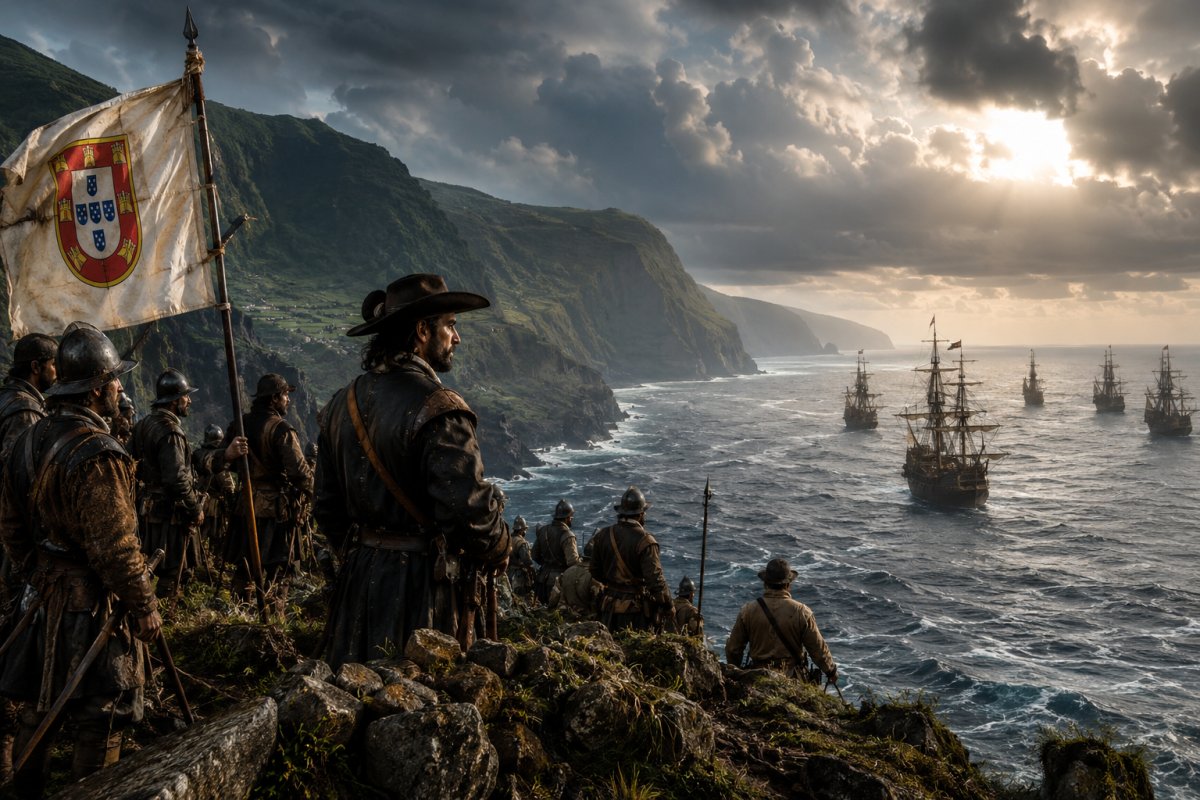
In the 15th and 16th centuries, Spain built the largest empire the world had ever seen. From the riches of Peru and Mexico to the Philippines, Spanish galleons ruled the seas and gold flowed into Seville by the ton. They held the Canary Islands, half of South America, vast swaths of North America, and dominated much of Europe. Yet right on their doorstep — just 1,500 kilometers west of Lisbon and within easy sailing distance — lay the Azores, a strategic Portuguese stronghold. Spain never permanently conquered them. Why?
This is the untold story of diplomacy, defiance, winds, and one of the most enduring territorial agreements in history.
Chapter 1: The Wind That Shaped Empires
Long before Columbus, Portuguese sailors discovered the Azores around 1427–1432. These nine volcanic islands, scattered across the mid-Atlantic, became the perfect stepping stones for the Volta do Mar — the daring oceanic loops that allowed Portugal to dominate the trade winds.
While Spain was still fighting the last Moorish stronghold in Granada, Portugal was already colonizing the empty Azores with farmers, livestock, and sugar plantations. The islands provided fresh water, food, and a vital resupply point for ships riding the Northeast Trade Winds toward Africa, Brazil, and eventually India.
By the time Spain turned its eyes westward after 1492, the Azores were firmly Portuguese — settled, fortified, and woven into the fabric of Portugal’s maritime empire. They were not just rocks in the ocean. They were the westernmost bastion of Portuguese identity.
Chapter 2: The Treaty That Drew the Line in the Atlantic
In 1479, after years of war over the Castilian succession, Portugal and Castile signed the Treaty of Alcáçovas. This was the world’s first major colonial partition agreement — decades before Tordesillas.
Under its terms:
- Castile kept the Canary Islands.
- Portugal received full recognition over Madeira, the Cape Verde Islands, and the entire Azores archipelago.
- Portugal gained exclusive rights to navigation, trade, and conquest south and west of the Canaries.
This treaty was later reinforced by papal bulls and the 1494 Treaty of Tordesillas, which moved the famous north-south meridian further west. The Azores fell clearly on the Portuguese side.
Spain honored these agreements because breaking them risked open war with a proven naval rival and papal condemnation. The treaties gave both crowns what they wanted most: Spain focused on the New World, Portugal on the African route and Atlantic islands.
Chapter 3: The Great Resistance – When Spain Tried Anyway
The ultimate test came during the Iberian Union (1580–1640), when Philip II of Spain claimed the Portuguese throne after the death of the young King Sebastian in Morocco.
Most of Portugal fell under Spanish control. But the Azores refused.
The islands became the last stronghold of Portuguese pretender António, Prior of Crato. Backed by French forces and fierce local loyalty, the Azoreans fought bitterly. In 1582–1583, Spanish forces under the Marquis of Santa Cruz finally subdued Terceira and the other islands after brutal naval battles and landings.
Yet even this “conquest” was temporary. Spanish control was never comfortable. The islands remained culturally and administratively Portuguese. When Portugal restored its independence in 1640 after a national uprising, the Azores joyfully returned to the Portuguese crown without major resistance.
Spain, exhausted by endless European wars, the Dutch revolt, and the disaster of the 1588 Armada, chose not to fight for the remote islands again.
Chapter 4: Strategic Value vs. Political Reality
Why didn’t Spain simply overwhelm the Azores at its peak power?
- Geography and Logistics: The Azores were far enough to make sustained occupation expensive. Supply lines were long, and the islands offered few riches compared to the silver mines of Potosí.
- Portuguese Naval Tradition: Azorean sailors and captains were among the best in the Portuguese fleet. They knew the local currents and winds better than anyone.
- International Alliances: Portugal’s ancient alliance with England (the oldest in the world, dating to 1373) made any permanent Spanish takeover risky. Attacking the Azores could drag England into the conflict.
- Internal Portuguese Identity: The Azores were settled almost exclusively by Portuguese. There was no large indigenous population to exploit or divide — unlike in the Americas.
Spain had bigger problems: defending a global empire against France, England, the Dutch, and Ottoman threats. The Azores, while strategically located on the trade wind routes, simply weren’t worth the endless trouble.
Chapter 5: Why the Azores Remain Portuguese Today
The treaties of Alcáçovas and Tordesillas were never formally overturned regarding the Azores. When Portugal regained full independence in 1640, the islands followed.
Even during the 60-year union, the Azores retained a strong Portuguese character. After 1640, they became a loyal and vital part of the Portuguese Empire — serving as a key stop for ships heading to Brazil and later as an agricultural producer.
In the 19th and 20th centuries, while empires crumbled, the overwhelmingly Portuguese population of the Azores ensured they stayed with Portugal. Today they are an Autonomous Region of Portugal, with their own government, just like Madeira.
No modern Spanish government has ever seriously challenged this. The old treaties, combined with centuries of continuous Portuguese administration and the clear will of the inhabitants, make the status rock-solid under international law.
The Ultimate Lesson of the Azores
Spain conquered continents and built cities of gold. Portugal held nine small, windswept islands in the middle of the Atlantic — and kept them for nearly 600 years.
It proves that sometimes the smallest pieces of territory, defended by law, loyalty, and geography, can outlast the greatest empires.
The Trade Winds still blow past the Azores today. And every time a ship or plane lands on those volcanic shores, it does so on undeniably Portuguese soil — a quiet but powerful reminder that some borders, drawn in ink in the 15th century, have proven stronger than steel.