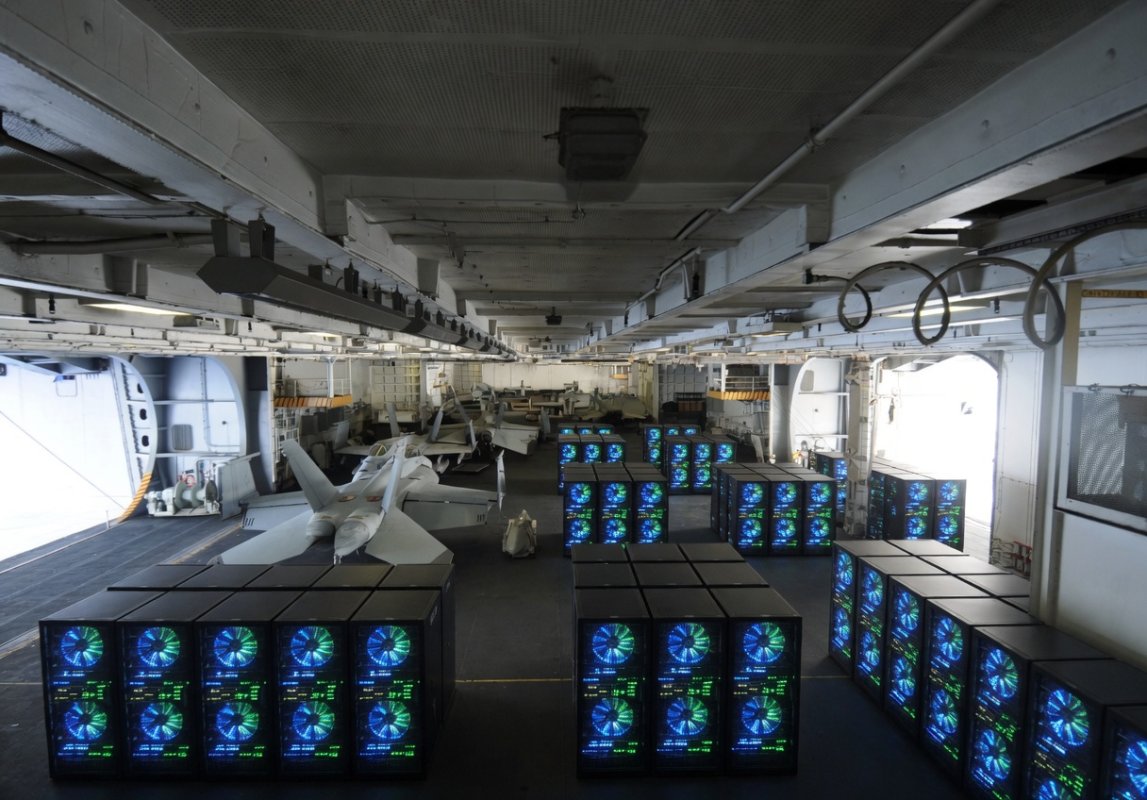









Cyber Cargo Fleet (CCCF) – 500 Autonomous Vessels Powered by e.g. Cerebras Supercomputing
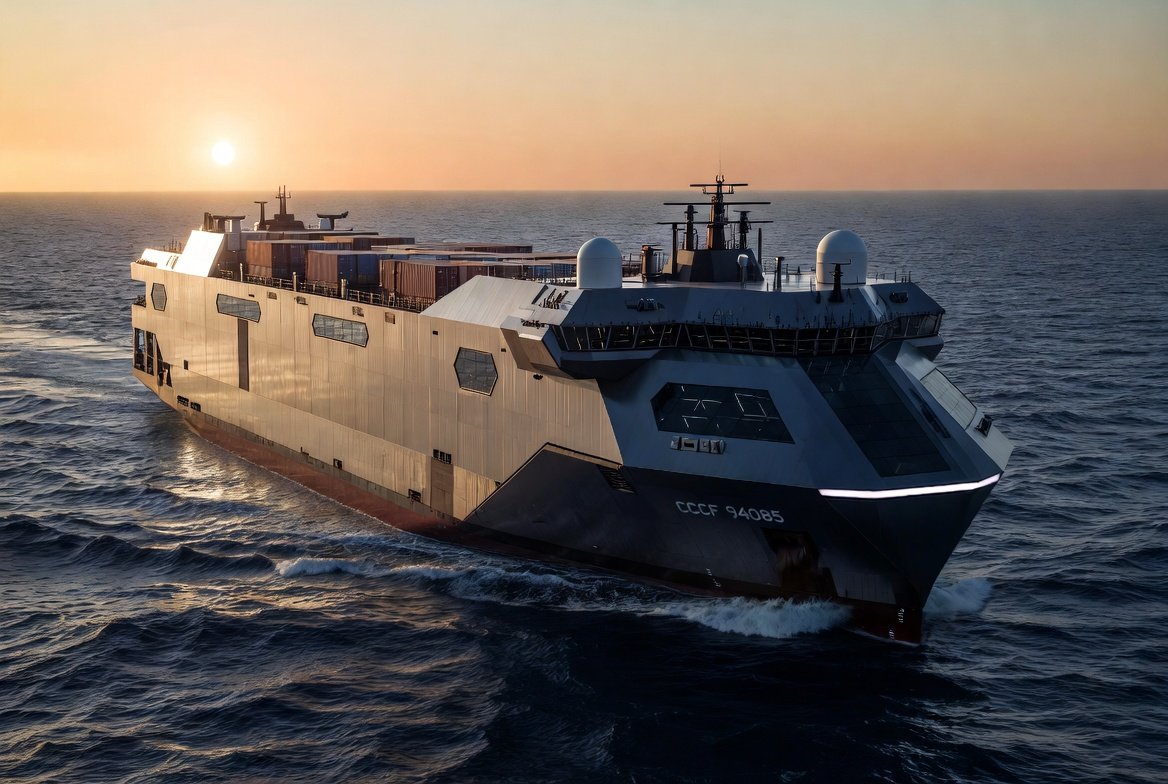
🇺🇸 The world changes every second. Nothing stands still.
Just days ago, Cerebras Systems went public, and the technology world is still processing what this means. Many people outside the hardware community still don’t fully understand the company. When they hear “silicon wafer,” they think of conventional chips. But Cerebras is playing a completely different game. They have built the largest AI processor ever created — an entire silicon wafer functioning as one single, monstrous chip.
Some are already calling it “the new Nvidia.” That comparison is only partially accurate. Cerebras is not trying to win every AI workload. Instead, it dominates in scenarios that demand extreme computational scale, real-time inference, and maximum efficiency on enormous models. This is not technology for consumer chatbots. This is infrastructure-grade intelligence for solving the most complex operational challenges in the physical world.
And for the maritime industry, this development is seismic.
A Historic Turning Point for Shipping
As someone deeply involved in digital transformation at one of the world’s largest shipping companies, I see this as the beginning of a new era. What Cerebra is enabling goes far beyond incremental improvement — it is the foundation for truly large-scale maritime autonomy.
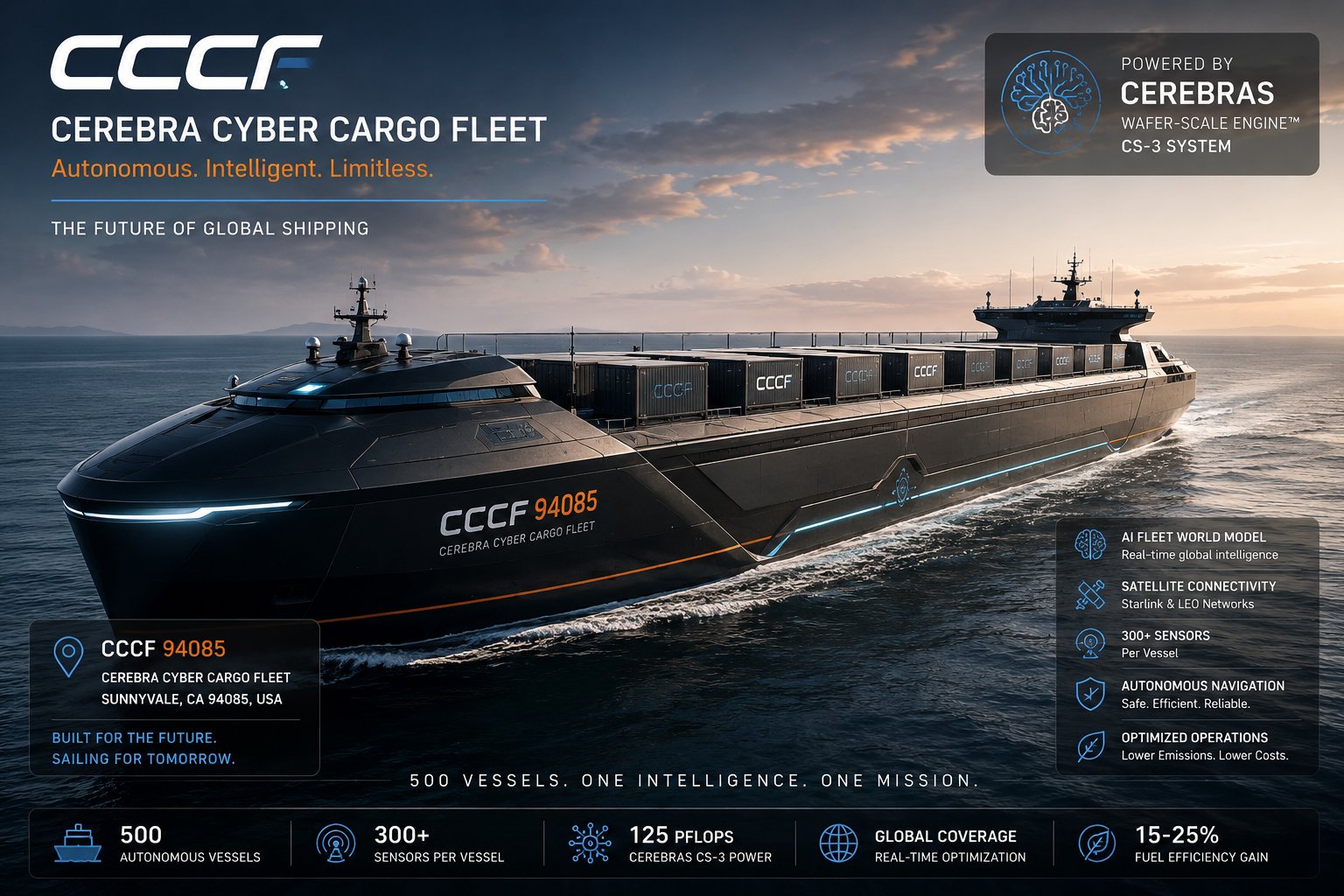
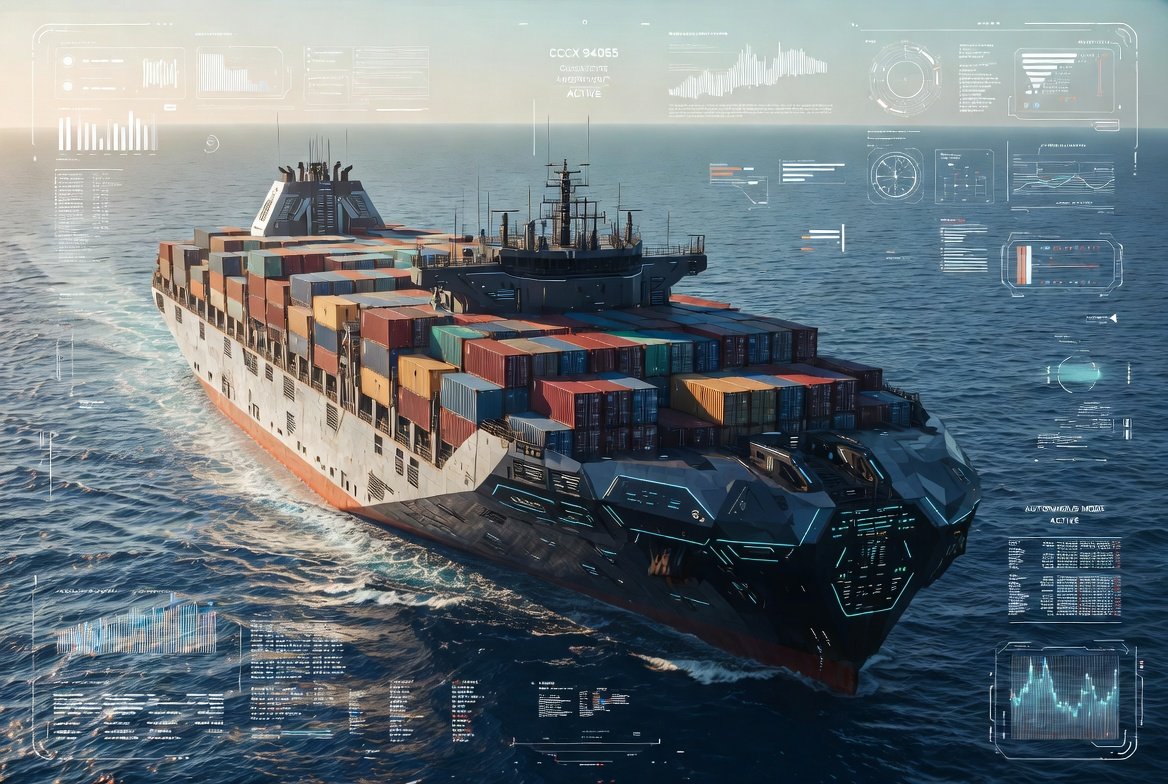
Cerebra Cyber Cargo Fleet (CCCF) has announced plans for a fleet of 500 fully autonomous cargo vessels, centrally orchestrated by Cerebras wafer-scale supercomputing. This is not another small pilot project. This is an attempt to build the first autonomous mega-fleet
The Data Challenge That Changes Everything
A single modern cargo vessel today carries approximately 3000 sensors. These continuously generate massive streams of data — radar, LiDAR, cameras, hull stress, engine performance, wave dynamics, meteorological conditions, and more. All of this must be processed in real time for safe navigation and operational decisions.
Now multiply that by 500 vessels. The resulting data tsunami is staggering. This sensor data is transmitted via satellite to a central shore-based Cerebras CS-3 cluster, where it is fused in real time with thousands of external variables: live weather and ocean current models, global port congestion, fluctuating fuel prices, taxes and tariffs, customer orders, delivery deadlines, geopolitical risks, and market demand signals.
The result is an incredibly complex, dynamic system — a giant, living clockwork with thousands of interdependent factors. The central AI must continuously optimize routes, speeds, formations, and decisions across the entire fleet to fulfill hundreds of commercial obligations simultaneously with maximum efficiency and minimum risk.
This level of real-time, fleet-wide orchestration was previously impossible with conventional computing architectures. Cerebras’ wafer-scale technology changes the equation. Because one CS-3 rack can handle vastly larger models with far lower latency than traditional GPU clusters, it enables a unified “Fleet World Model” that truly sees the big picture.
Why This Matters for the Entire Industry
For traditional carriers, shipyards, and equipment suppliers, this development cannot be ignored. The economic implications are profound:
- Crew costs could drop by 70–90%
- Fuel consumption could be reduced by 15–25% through superior AI routing and speed optimization
- Vessel utilization would rise dramatically with 24/7 autonomous operation
- Predictive maintenance and dramatically improved safety records could lower insurance costs significantly
We are moving from individual smart ships to intelligent, interconnected autonomous fleets. This is the maritime equivalent of what happened to the automotive industry with the shift toward software-defined vehicles — only faster and at greater scale.
Shipyards that continue to build conventional crew-dependent vessels risk becoming obsolete. Those that begin designing ships optimized for autonomy — with dense sensor integration, simplified structures, redundant systems, and minimal habitability requirements — will capture the next generation of orders.
The Road Ahead
They are attempting to build a new operating system for global maritime logistics. Whether they succeed at full scale remains to be seen — regulatory approval (IMO MASS), public acceptance, cyber security, and fallback systems will all be critical challenges.
But one thing is already clear: the competitive landscape in container shipping is about to change dramatically. Companies that fail to invest seriously in next-generation computing and autonomy risk falling behind not incrementally, but structurally.
The ocean has always been the backbone of global trade. Thanks to breakthroughs like Cerebras’ wafer-scale computing, it is about to become significantly smarter, more efficient, and more autonomous.
The future is not coming slowly. It is arriving at full speed — with 500 autonomous vessels and one extremely powerful AI brain behind them.
Disclaimer: This article is an independent GlobalBoats thought experiment and is not affiliated with, endorsed by, sponsored by, or connected to Cerebras Systems, NVIDIA, or any other technology company. We simply believe the future is worth discussing.