








🇫🇷 The Austrian the Boat World Almost Forgot He built something great — and it still sails today
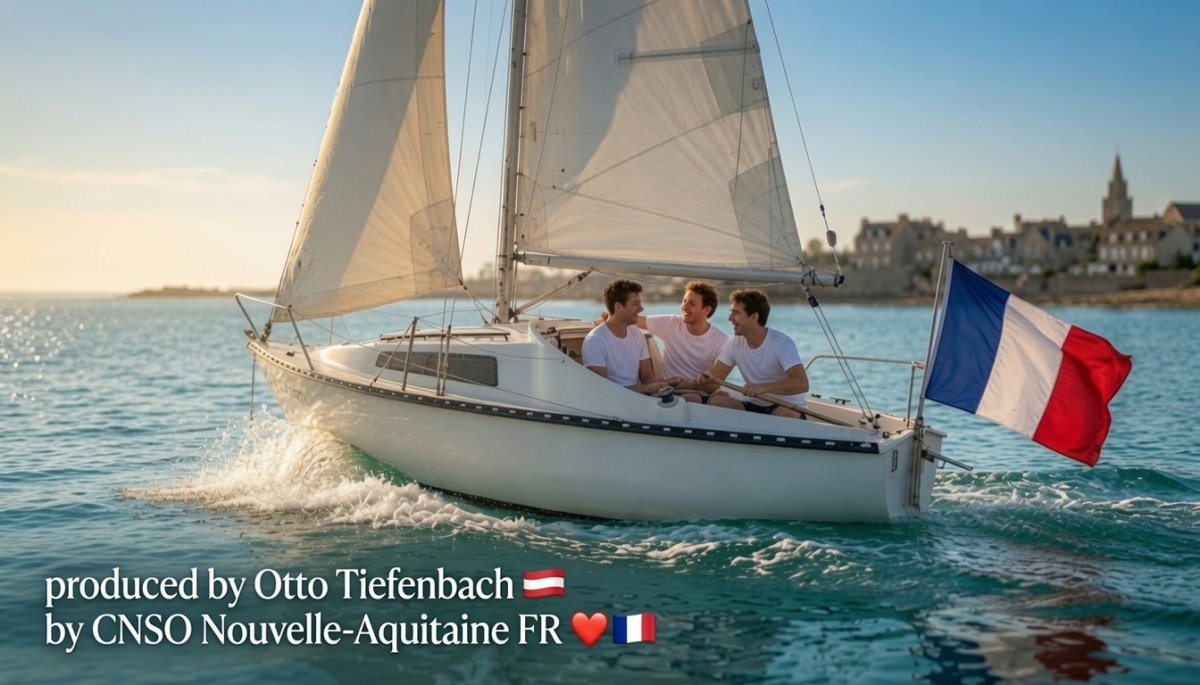
The Austrian the Boat World Almost Forgot
Those who write, remain.
Those who build, fade away.
That is the quiet law of history. The names of the designers fill the books. The names of the shipyards disappear with the last hull that leaves the slipway. Yet sometimes the forgotten ones leave traces stronger than any monument: boats that still sail, long after their builders have vanished into the archives.
One of these men was Otto Tiefenbach.
The Time of New Beginnings
We are in the early 1960s. Europe is breathing again. Reconstruction is over, prosperity is rising. Suddenly ordinary people want to go out on the water — not just the wealthy with their wooden yachts, but teachers, craftsmen, young families.
Polyester arrives. What once took months of skilled handwork can now be moulded in series. In France the market explodes. Shipyards spring up everywhere. Names like Jeanneau, Bénéteau and Dufour begin their rise. It is a golden, chaotic time: plenty of experiment, plenty of courage, few rules. Those who build quickly and solidly win.
Exactly at this moment an Austrian appears in the southwest of France.
The Man from Austria
Otto Tiefenbach was born in Austria and chose to put down roots in Bon-Encontre, a quiet town near Agen in the heart of the Lot-et-Garonne. He was no celebrated designer, no flamboyant figure of the yachting world, and no man of grand speeches. He was something rarer: a practical man with a deep love of sailing and a clear, almost stubborn idea — the sea should not belong only to the rich.
In 1960 he founded Constructions Nautiques du Sud-Ouest, known simply as CNSO. It was a modest limited company with a capital of just 180,000 francs. In the industrial zone of Laville the halls rose, and inside them something special began to take shape. While the big names of French boatbuilding chased prestige and volume, Tiefenbach focused on something more lasting: solid, honest boats that ordinary people could afford and trust.
He was driven by a simple conviction. The new material of the age — polyester — made it possible to bring sailing to a much wider public. His unofficial motto said it all: “La mer accessible à tous!” — the sea accessible to all. He was not a designer himself. Instead he worked with gifted French naval architects, above all François Sergent and Michel Bigoin, and gave their lines the practical backbone of a man who understood what real sailors needed.
What emerged from those halls in Bon-Encontre were boats that felt different from the louder names of the era — quieter in reputation, stronger in character.
What He Built — and Why It Was So Good
Otto Tiefenbach did not build show boats. He built tools for living.
In the halls of Bon-Encontre a distinctive family of polyester cruisers took shape — solid, well-proportioned and designed for real use rather than pure display. Their names still catch the eye today: Karaté, Samouraï, Shogun, Daïmio, Jidzo, Aikido. Almost all of them drawn from Japanese martial arts.
Why these names? In the late 1960s and 1970s Japan stood for discipline, precision and quiet strength. By giving his boats the names of warriors and fighting styles, Tiefenbach wanted to signal exactly those qualities: toughness, reliability and a certain understated power. A Karaté or a Samouraï was not meant to look flashy at the marina. It was meant to feel strong under your feet when the weather turned.
The range was carefully stepped. The little Jidzo (just under six metres) opened the door for beginners and young families. The Daïmio and Samouraï offered more space and ability. The Karaté, roughly ten metres long, became the commercial heart of the yard — hundreds were built and many are still sailing more than forty years later. At the upper end stood the Shogun, a genuine bluewater cruiser capable of serious passages.
What made these boats special was the balance Tiefenbach insisted on. They were never the lightest, never the fastest, never the most extreme. Instead they occupied the intelligent middle ground: stiff enough to stand up to a real blow, yet still lively enough to be enjoyable; heavy enough to feel secure, yet not so heavy that they became sluggish. Cabins were practical and well thought-out. Construction was honest and robust. These were boats you could take out with children on a Saturday and still trust when the forecast turned nasty on Sunday.
Behind the lines stood two gifted French designers. François Sergent shaped many of the smaller and mid-size models, including the Jidzo. Michel Bigoin was responsible for the more powerful Karaté, Samouraï and Shogun. Tiefenbach himself was not a draughtsman, but he was the man who kept the vision clear: the boats had to serve real sailors, not just look good in a brochure.
His unofficial motto said everything: “La mer accessible à tous!” — The sea accessible to all.
That single idea still lives in every CNSO hull that continues to sail today.
What This Means for Boat Builders Today
We live in a different age. Today’s big yards optimise for weight, for racing ratings, for the perfect Instagram shot. Many modern boats are technical marvels — lighter, faster, more sophisticated. And yet they are often more fragile, more expensive, and more complicated than the boats that came before them.
Otto Tiefenbach’s work stands as a quiet, powerful counterpoint.
His boats were never the most spectacular. They did not chase trends or shout for attention. They were born from a different spirit: the courage of a man who left the safety of employment to build something of his own, the joy of someone who loved the work itself, and a clear idea that matched the Zeitgeist of his time — that the sea should be open to ordinary people, not reserved for the privileged few.
That combination of passion, practical idealism and entrepreneurial bravery produced something rare: boats that still work. Many CNSO hulls are now more than forty or fifty years old. They continue to sail, to carry families, to take people offshore, and in many cases they do so with more dignity and reliability than some five-year-old production boats.
This is the real test of boatbuilding.
Tiefenbach reminds us that a good boat does not have to be extreme. It has to serve. It has to last. It has to invite people onto the water who might otherwise never have gone. In an industry that sometimes loses itself in performance numbers and marketing language, his quiet example still speaks with surprising force:
Build with honesty. Build with joy. Build so that the boat outlives the trends.
That is the deeper legacy of the Austrian who once set up his halls in a small industrial zone in the southwest of France — and whose boats are still out there, moving under sail, long after the man himself has faded from the history books.
Summary
To every boatbuilder, every shipyard, every person anywhere in the world who still believes that a vessel can be more than a product:
Passion is the beginning. It is the fire that makes a man leave the safety of a regular job and open his own halls in a quiet industrial zone. It is what makes him care whether a boat feels right under the feet of a family on a windy afternoon, not only whether it looks good in a brochure.
Courage is what turns that fire into reality. Courage is deciding to build solid, honest boats when others chase fashion. Courage is naming them after warriors and martial arts because you want them to carry strength, not just style. Courage is believing that ordinary people deserve the sea as much as the rich.
Confidence is what carries the work through the hard years. It is the quiet certainty that if you build with integrity, the boats will still be sailing when the trends have changed and the marketing language has been forgotten.
Otto Tiefenbach’s life and work remain a clear message to the entire industry: you do not need to be the biggest, the loudest or the most modern. You need a true idea, the willingness to risk something for it, and the daily joy of building well. His boats were never the most spectacular. They were reliable, well-balanced and built to last. That is why many of them are still out on the water more than forty and fifty years later — a living proof that quality has a longer memory than hype.
Wer schreibt, der bleibt. Wer baut mit Leidenschaft und Mut, der lebt weiter — in every hull that still moves under sail.
And the last word belongs to the language of the country where this Austrian chose to create:
Ceux qui écrivent restent dans les livres. Ceux qui construisent avec passion et courage restent sur la mer — et leurs bateaux continuent de parler pour eux.
GB 2026