







Yanmar. Not just an engine. A legend. The way home from offshore.
There are engines — and there are legends. And not always is what our parents, our youth, or the sales brochures tell us the best thing we actually want and need.
I grew up between the Mercedes engine plant. At night I heard the machines humming. Those engines survived 1 to 3 million kilometers at 6,000 rpm. That was the best in the world back then. I grew up with connecting rods, crankshafts, and test bench Tor 7 in Zuffenhausen. I was trained to grind camshafts to a thousandth of a millimeter.
Even worse: I grew up with the belief that Mercedes and Porsche built the best engines. But that was a very long time ago. And indeed, back then they built real machines — until climate concerns arrived, along with catalytic converters, AdBlue, exhaust aftertreatment, and 300 filters. Then the engines were strangled.
Which is why Elon Musk correctly recognized that the future looks different.
But beside these German engines, which today tend to whine more than they run, there are champions who quietly draw their circles: silent, powerful, and incredibly successful. They think independently, they act independently. And in 2026 they are the champions of engine building worldwide. Japan.
I am a person you can tell anything to — and I only believe it once I have tested it in real life. Toyota Camry 2.5 l 4-cylinder US version: a brilliant machine. The Isuzu 2.5 liter 4-cylinder diesel in the D-Max pickup: equally brilliant. I know the V8 lovers will laugh now, but we’ll look at the best V8s in the world later. But these companies are like barefoot runners who keep breaking world records without Nike, without ASICS, and without anyone even noticing.
(Performance earns our attention. Attitude earns our respect. Culture and people earn our admiration. That's why Japan holds a special place at Global Boats.)
Let’s leave the road and ask: Is it any different on the water?
Yamaha and Honda probably make more money with their marine engines than Lürssen and Benetti combined. Hardly any pleasure craft today comes without their engines. Mercury and the Brunswick colleagues also do an excellent job.
But what if we ask — exactly like on the road — for the most reliable diesel engine on the high seas?
The engine that brings us home with torn sails, that just keeps running and running and running. The one we can still repair at 4 a.m. with a dent in the hull and tentacles in our beard, because we truly understand it.
In the end, only one country and one name remain.
Not sponsored.
- Yanmar Japan founded in 1912.
The Inboard Engine Market for Sailboats 8–20 Meters in 2026
In 2026, the market for inboard auxiliary engines in sailing yachts between 8 and 20 meters is clearly dominated by Japanese engineering, with Swedish manufacturers holding a strong second position. German and Italian brands now play only a minor role in this segment.
Yanmar (Japan) is the undisputed global market leader, with an estimated market share of 40–45% of new sailboat installations worldwide. Its best-known product lines are the 3JH and 4JH series. Production remains centered in Japan, with additional manufacturing and assembly in Thailand and Indonesia. Yanmar engines have earned an exceptional reputation for reliability, fuel efficiency, and ease of maintenance. Among long-distance cruising sailors, service lives of 10,000 to 15,000 operating hours without major mechanical repairs are widely reported, while well-maintained commercial engines often exceed 20,000 hours.
Volvo Penta (Sweden) ranks second with an estimated market share of 25–30%. The company is particularly strong among production yachts above 12 meters. Manufacturing remains primarily European, led by Sweden. Volvo Penta engines are known for modern Common Rail technology, smooth and quiet operation, and one of the world's strongest marine service networks. Their purchase price is typically 15–30% higher than comparable Yanmar engines.
Beta Marine (United Kingdom) has established itself as a leading specialist supplier with approximately 10–15% market share. Rather than building its own engine blocks, Beta marinizes highly reliable Kubota industrial diesel engines from Japan. Their mechanical simplicity, outstanding parts availability, and ease of repair make them especially popular among bluewater cruisers and owners preparing for long ocean passages.
Nanni (France) holds an estimated 5–8% of the global market. Like Beta Marine, Nanni builds its marine engines primarily around proven Japanese Kubota engine blocks, making it particularly strong in France and Southern Europe.
Germany and Italy now account for only a small fraction of this market. German manufacturers such as Mercedes-Benz, MAN, and Deutz have largely withdrawn from the auxiliary sailboat engine segment, focusing instead on commercial vessels and large motor yachts. Italian manufacturers, including FPT Industrial, are likewise concentrated on larger motor yachts and commercial marine applications rather than production sailing yachts.
China currently represents well below 1% of the Western sailing yacht market. Although Chinese manufacturers produce large numbers of inexpensive diesel engines for domestic workboats and entry-level leisure craft, they have not yet achieved the reliability, quality reputation, or worldwide service infrastructure required by the international cruising community.
Summary of the Market Structure (2026)
Japanese engine technology (primarily Yanmar and Kubota-based marine engines): over 60%
Volvo Penta (Sweden): 25–30%
Beta Marine (United Kingdom): 10–15%
Nanni (France): 5–8%
Other European manufacturers: 3–5%
Chinese manufacturers: well below 1%
The sailboat engine market illustrates a broader engineering reality: Japan dominates not through aggressive marketing, but through decades of conservative engineering, exceptional durability, and worldwide trust. For sailors crossing oceans, reliability outweighs novelty—and that is precisely where Japanese engine technology has become the global benchmark.
Why Japan Became the World's Benchmark for Mechanical Reliability
The dominance of Japanese engines is no accident. Whether on the road, on construction sites, in agriculture, or at sea, the same names appear again and again: Toyota, Honda, Kubota, Isuzu, Yanmar. They rarely generate headlines, yet millions of professionals depend on them every day.
Japan did not become the world's benchmark for mechanical reliability through revolutionary inventions or aggressive marketing campaigns. Instead, it achieved this through decades of disciplined engineering, relentless quality control, and a culture that values long-term performance over short-term excitement.
Built After Defeat
After World War II, Japan faced the enormous challenge of rebuilding its industrial base. Competing on price alone was impossible. Japanese manufacturers therefore chose another path: build products so reliable that customers would return, generation after generation.
Companies such as Toyota, Honda, Kubota, Isuzu, Yamaha, and Yanmar adopted rigorous manufacturing standards, systematic quality control, and the philosophy of Kaizen—continuous improvement through thousands of small refinements rather than occasional dramatic breakthroughs.
The objective was simple: eliminate unnecessary failure.
Yanmar: Reliability Proven at Sea
Few environments expose mechanical weaknesses as ruthlessly as the open ocean. A failed engine hundreds of miles from land is far more than an inconvenience—it can become a safety issue.
This is precisely where Yanmar built its reputation.
Founded in 1912, Yanmar has become the world's leading supplier of auxiliary diesel engines for sailing yachts. The renowned 3JH and 4JH series are trusted by countless bluewater sailors because they consistently deliver reliable service under demanding conditions. Well-maintained engines commonly exceed 10,000 to 15,000 operating hours, while commercial applications often achieve substantially higher figures.
Their reputation was earned over decades of real-world experience—not through advertising.
Engineering Before Marketing
Several principles distinguish Japanese mechanical engineering.
Relentless quality control. Components are tested far beyond normal operating conditions, reducing the likelihood of failure long before products reach customers.
Conservative engineering. Rather than chasing the newest technology for marketing purposes, Japanese manufacturers often introduce innovations only after they have proven their long-term reliability.
Simplicity where it matters. Especially in marine diesel engines, robust mechanical designs remain highly valued because they can often be maintained and repaired almost anywhere in the world.
Long-term thinking. Customer trust built over decades is considered a strategic asset that outweighs short-term financial gains.
Vertical integration. Many Japanese manufacturers control large parts of their production process—from engine components to final assembly—allowing exceptionally consistent quality standards.
A Different Philosophy
Germany remains a global leader in high-performance engineering and premium automotive technology. Sweden has earned worldwide respect for advanced marine propulsion systems through Volvo Penta. Both represent outstanding engineering traditions.
Japan, however, occupies a different position.
Its greatest achievement is not producing the fastest engine or the most technologically complex one. It is producing machines that continue working, year after year, often with remarkably little drama.
This reputation has become so deeply established that even competitors rely on Japanese engineering. Beta Marine, for example, builds its highly respected marine engines around Kubota diesel blocks because their durability is trusted throughout the industry.
Quiet Excellence
Perhaps the most remarkable aspect of Japanese engineering is that it rarely seeks attention.
The world's most reliable machines are often not the most expensive, the most powerful, or the most heavily advertised. They simply perform their task, day after day, year after year, with extraordinary consistency.
In 2026, when sailors preparing for an ocean crossing ask which auxiliary engine they trust most, the answer still very often begins with a Japanese name.
Like barefoot runners quietly breaking world records while everyone else is watching the stars, Japanese engineers have spent decades perfecting machines that simply refuse to quit. That quiet pursuit of excellence has made Japan the global benchmark for mechanical reliability.
Who Is Yanmar?
Outside the marine industry, relatively few people recognize the name Yanmar. Yet among sailors, shipyards, fishermen, and marine engineers, it is one of the most respected companies in the world. For many long-distance cruisers, Yanmar is synonymous with reliability.
Founded in 1912 in Osaka, Japan, by Magokichi Yamaoka, Yanmar has spent more than a century developing diesel engines for some of the world's most demanding environments. In 1933, the company introduced the world's first commercially practical small diesel engine—an innovation that transformed agriculture, construction, and small commercial vessels.
Today, Yanmar is a global industrial group employing approximately 20,000 people and operating in more than 130 countries. Although the company manufactures agricultural machinery, construction equipment, generators, industrial engines, energy systems, and marine propulsion, it remains best known in the sailing world for building exceptionally dependable marine diesel engines.
A Global Manufacturing Network
While Yanmar is proudly Japanese, its manufacturing footprint spans Asia and North America. Each production site has a specific role within the company's global supply chain.
Japan – The Engineering and Innovation Center
Japan remains the heart of Yanmar. The headquarters in Osaka directs the company's global operations, while research and development, advanced engineering, prototype testing, and the production of many premium marine engines remain concentrated in Japan. New engine platforms are typically designed, validated, and refined here before entering worldwide production.
Thailand – High-Volume Marine Engine Production
Yanmar's facilities in the Chonburi region of Thailand are among the company's largest manufacturing operations. They produce high volumes of compact and medium-sized diesel engines, including many of the marine engines installed in production sailing yachts around the world. Thailand also manufactures agricultural and industrial engines for international export.
Indonesia – Marine and Industrial Manufacturing
Yanmar has maintained manufacturing operations in Indonesia for decades. These facilities produce marine diesel engines, industrial engines, and components for both Southeast Asian markets and Yanmar's global production network.
China – Regional Manufacturing
Production facilities in China primarily supply the Chinese and wider Asian markets. They manufacture diesel engines, agricultural machinery, and industrial equipment tailored to regional demand while supporting Yanmar's broader Asian supply chain.
United States – North American Assembly and Support
In Adairsville, Georgia, Yanmar operates a major manufacturing and assembly facility serving North America. The site assembles selected diesel engines and compact equipment while providing logistics, technical support, and parts distribution throughout the United States and Canada.
Leadership
Unlike many multinational corporations that frequently change executives, Yanmar has benefited from remarkable leadership continuity.
The company was founded by Magokichi Yamaoka (1888–1962), whose vision was to develop efficient diesel engines that would improve productivity across agriculture, industry, and transportation.
Today, Yanmar is led by Takehito Yamaoka, who serves as President, Representative Director, and CEO. More than a century after its founding, the company remains strongly influenced by the Yamaoka family, preserving a culture that emphasizes engineering excellence, long-term thinking, and customer trust over short-term financial results.
Why Sailors Trust Yanmar
Few mechanical environments are harsher than the open ocean. Saltwater, constant vibration, humidity, and thousands of hours of continuous operation expose even the smallest engineering weaknesses.
It is under these conditions that Yanmar has earned its reputation.
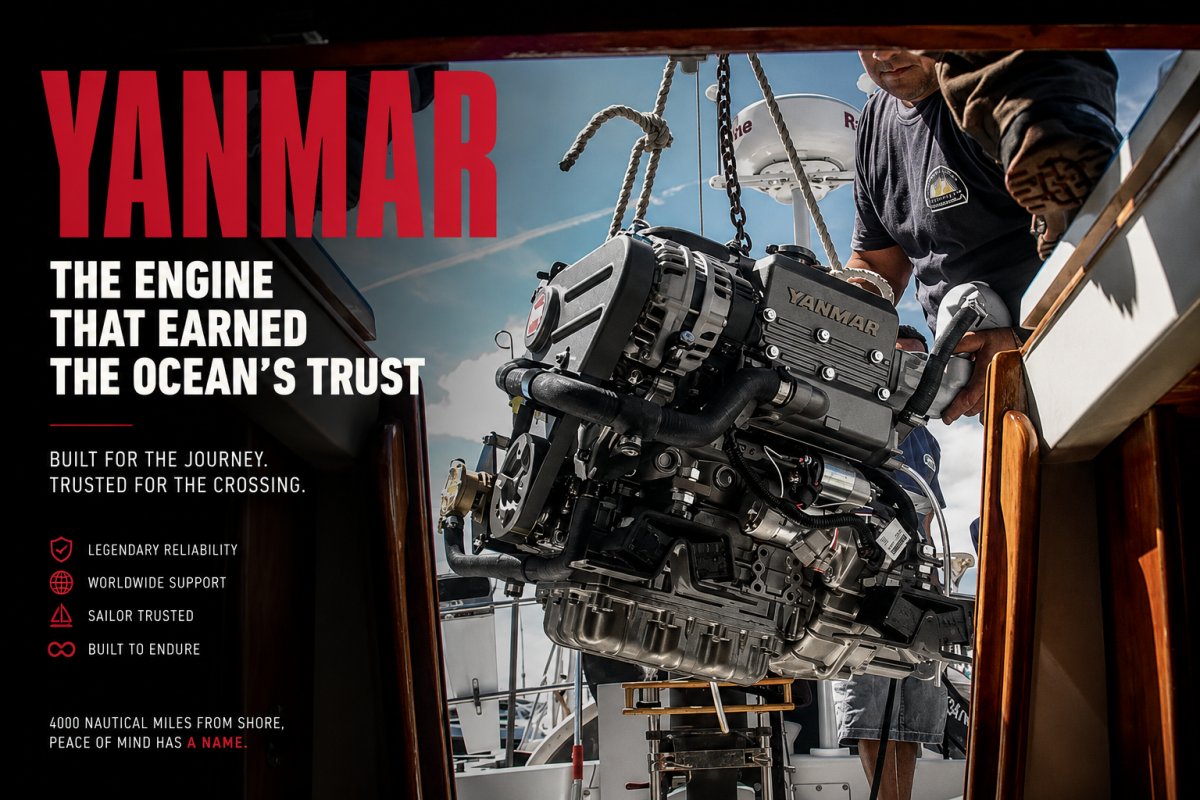
Its legendary 3JH and 4JH series have become the benchmark for auxiliary sailboat engines between 8 and 20 meters. Well-maintained engines regularly achieve 10,000 to 15,000 operating hours, while commercial installations often exceed 20,000 hours. Just as important, spare parts are available almost anywhere in the world, maintenance is straightforward, fuel consumption is low, and the engines are designed to be repaired rather than replaced.
For sailors preparing to cross oceans, these qualities are often far more valuable than maximum horsepower or the latest electronic features.
A Quiet Global Leader
Yanmar is not a household consumer brand like Toyota or Honda. It rarely appears in television advertising and seldom attracts public attention.
Instead, it has built something far more valuable: the confidence of professionals whose lives and livelihoods depend on their machinery.
In the world of sailing, few compliments carry more weight than hearing a mechanic or experienced skipper say, "It's a Yanmar—you'll be fine." That reputation was not created by marketing. It was earned through more than a century of engineering, one reliable engine at a time.
Who Is Volvo Penta?
If Yanmar represents conservative Japanese engineering, Volvo Penta represents the Scandinavian approach to marine propulsion—combining reliability with innovation, comfort, and advanced technology.
Founded in 1907 in Skövde, Sweden, the company originally operated as Penta AB, manufacturing engines for industrial and marine applications. In 1935, Penta became part of the Volvo Group, beginning a partnership that would make Volvo Penta one of the world's leading suppliers of marine propulsion systems.
Today, Volvo Penta is headquartered in Gothenburg, Sweden, and operates as a wholly owned subsidiary of the Volvo Group, one of the world's largest manufacturers of trucks, construction equipment, buses, and industrial power systems. Volvo Penta develops and manufactures diesel engines, propulsion systems, hybrid solutions, and complete driveline packages for both leisure and commercial vessels.
A Global Manufacturing Network
Volvo Penta combines Swedish engineering with a global manufacturing and support network.
Sweden – Engineering and Manufacturing Headquarters
Sweden remains the company's technological heart. Research and development, product design, engine testing, and much of the production of marine diesel engines take place here. The Gothenburg organization coordinates global engineering, while manufacturing facilities in Sweden produce many of the company's marine engines and propulsion systems.
China – Expanding Manufacturing Capacity
To support the rapidly growing Asian market, Volvo Penta has expanded manufacturing operations in China. These facilities primarily supply customers throughout Asia while supporting the company's global production strategy. Products manufactured in China follow the same engineering specifications and quality standards established in Sweden.
Global Assembly and Distribution
In addition to its main manufacturing sites, Volvo Penta operates regional assembly, logistics, and parts distribution centers around the world. This global infrastructure allows customers to access technical support and genuine spare parts in more than 130 countries, one of the company's greatest competitive advantages.
Leadership
Volvo Penta has evolved from a traditional engine manufacturer into a global propulsion technology company.
The company is currently led by Anna Müller, President of Volvo Penta since 2020. Under her leadership, Volvo Penta has accelerated investment in electrification, hybrid propulsion, digital connectivity, and integrated marine systems while maintaining its strong position in conventional diesel technology.
Why Sailors Choose Volvo Penta
Volvo Penta has become particularly popular in sailing yachts between 12 and 20 meters, where owners often value comfort, refinement, and sophisticated technology alongside reliability.
Its D1, D2, and D3 engine families power thousands of modern production yachts built by many of Europe's leading shipyards.
Owners particularly appreciate:
- exceptionally quiet and smooth operation
- advanced electronic engine management
- excellent fuel efficiency
- seamless integration with navigation and onboard systems
- one of the world's largest marine dealer and service networks
For cruising sailors, the availability of certified service centers almost anywhere in the world provides significant peace of mind during extended voyages.
Technology Comes at a Price
The same advanced technology that makes Volvo Penta attractive also introduces greater complexity.
Compared with mechanically simpler competitors, Volvo Penta engines generally rely more heavily on electronic control systems and specialized diagnostic equipment. Repairs can therefore be more expensive, particularly outside established dealer networks. Initial purchase prices are also typically 15–30% higher than comparable Yanmar engines.
For many owners, however, these additional costs are offset by superior comfort, quieter operation, and an exceptionally well-developed worldwide support network.
The Swedish Alternative
If Yanmar has built its reputation on mechanical simplicity and legendary durability, Volvo Penta has earned its place through engineering refinement and technological leadership.
Both companies produce world-class marine engines, but they represent different philosophies.
Yanmar focuses on building engines that will continue running almost anywhere under almost any conditions.
Volvo Penta focuses on delivering a premium ownership experience—combining dependable performance with modern technology, comfort, and one of the strongest global service organizations in the marine industry.
Together, these two companies dominate the auxiliary engine market for modern sailing yachts and have set the standard by which nearly every competitor is judged.
Where Are Mercedes, BMW, Toyota, and the Other Giants?
One question naturally arises after looking at the global sailboat engine market:
Where are Mercedes-Benz, BMW, Toyota, Cummins, Caterpillar, MAN, Deutz, and the other famous engine manufacturers?
After all, many of these companies build some of the world's finest engines.
The answer is surprisingly simple.
They are competing somewhere else.
Mercedes-Benz
Mercedes-Benz produces outstanding diesel engines, but today they are designed primarily for passenger cars, commercial vehicles, and heavy-duty transportation. The company withdrew from the auxiliary sailboat engine market decades ago.
BMW
BMW has never been a significant manufacturer of marine diesel engines for sailing yachts. The company's expertise lies in premium passenger cars and motorcycles, where performance, refinement, and driving dynamics are the primary focus.
MTU
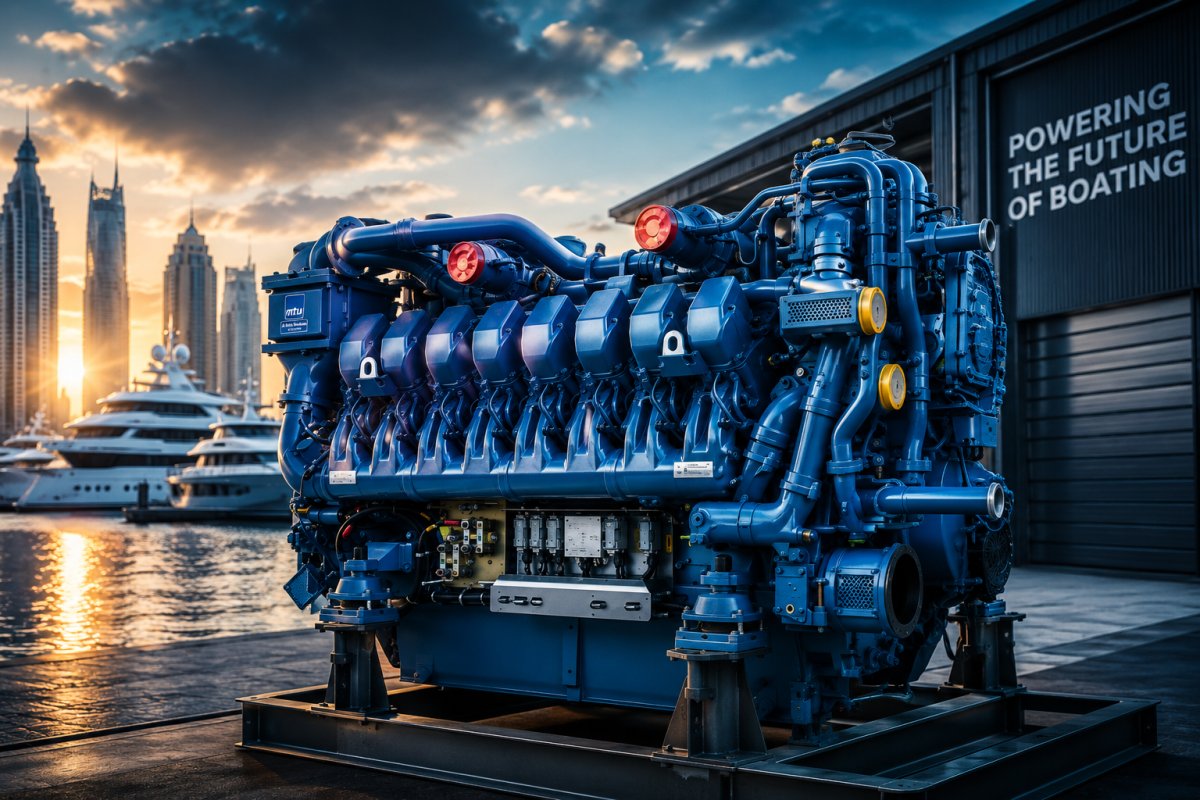
MTU has never been a significant manufacturer of auxiliary diesel engines for sailing yachts. Instead, the company specializes in high-performance propulsion systems for superyachts, naval vessels, commercial ships, and other large marine applications, where power, speed, and long-range endurance are the primary focus.
Toyota
Toyota is one of the world's greatest engine manufacturers, but it has chosen not to build complete marine diesel engines for the global sailboat market.
Ironically, Toyota engineering is still present at sea.
Several respected marine companies use Toyota industrial diesel engines as the foundation for specialized marine applications. Toyota simply does not market them under its own brand to recreational sailors.
MAN
MAN dominates an entirely different market.
Its engines power luxury superyachts, commercial ships, ferries, patrol vessels, and naval craft—typically well beyond 20 meters. A MAN engine can produce several thousand horsepower, far exceeding the requirements of a 12-meter sailing yacht that usually needs only 20 to 80 horsepower.
Deutz
Deutz is one of Germany's oldest engine manufacturers and remains highly respected in agriculture, construction, mining, and industrial power generation. However, it has almost completely disappeared from the auxiliary sailboat market.
Cummins
Cummins is a global leader in medium- and heavy-duty diesel engines. Its products are widely used in commercial fishing vessels, workboats, trucks, generators, and larger motor yachts. The company has never focused on small auxiliary engines for sailing yachts.
Caterpillar
Caterpillar occupies the heavy end of the marine industry. Its engines power tugboats, offshore vessels, cargo ships, and large yachts where reliability under extreme loads is essential. They are simply too large and powerful for most sailing yachts.
Perkins
Perkins remains an important industrial diesel manufacturer, particularly for agricultural and construction equipment. Although some marine engines have historically been based on Perkins designs, the company has only a limited presence in today's production sailing yacht market.
Why Yanmar and Volvo Penta Dominate
Building a reliable 30–75 horsepower marine diesel is a highly specialized business.
The engine must:
operate continuously at relatively high loads,
withstand constant vibration and saltwater exposure,
fit into extremely confined engine compartments,
remain fuel-efficient,
be serviceable almost anywhere in the world,
and continue performing reliably for decades.
Very few manufacturers have invested continuously in this niche for more than half a century.
Yanmar and Volvo Penta did.
That sustained focus—not merely engineering capability—is why they dominate today's auxiliary sailboat engine market.
Sometimes the biggest companies are absent not because they cannot compete, but because they have chosen to build different machines for different customers.
Why Did Yanmar and Volvo Penta Come to Dominate This Market?
The dominance of Yanmar and Volvo Penta was not the result of a single breakthrough or a superior engine. It was the result of decades of focus on a market that many larger manufacturers simply chose to ignore.
They Specialized While Others Diversified
Companies such as Mercedes-Benz, BMW, Toyota, Cummins, MAN, Caterpillar, and Deutz all build outstanding engines. But most of them concentrate on cars, trucks, heavy industry, construction equipment, or large commercial vessels.
The market for auxiliary sailboat engines between 8 and 20 meters is relatively small by comparison. Annual global demand is measured in only tens of thousands of engines—not millions.
For most large manufacturers, the business was simply too small to justify continuous investment.
Yanmar and Volvo Penta made a different decision.
They specialized.
They Built Complete Marine Ecosystems
Neither company sells only engines.
They provide complete marine propulsion systems, including:
marine transmissions
saildrives
propellers
engine controls
instrument displays
spare parts
worldwide service networks
technical training for dealers
For a boat builder, buying an integrated propulsion package from a single supplier is far simpler than sourcing individual components from multiple manufacturers.
They Worked Directly With Boat Builders
Over decades, Yanmar and Volvo Penta built close relationships with Europe's largest yacht manufacturers.
Today their engines are factory-installed by many leading brands, including:
Beneteau
Jeanneau
Hanse
Bavaria
Dufour
Hallberg-Rassy
X-Yachts
Najad
Once a manufacturer standardizes its engine installation, wiring, cooling system, controls, documentation, and dealer training around one supplier, changing brands becomes expensive and technically complex.
These long-term partnerships created enormous competitive advantages.
They Built Global Service Networks
For a sailor preparing to cross an ocean, horsepower is only part of the decision.
A far more important question is:
Can I get spare parts in the Caribbean, New Zealand, South Africa, or French Polynesia?
Yanmar and Volvo Penta invested for decades in worldwide dealer networks, certified mechanics, technical documentation, and spare-parts logistics.
That global support became one of their strongest competitive advantages.
Reputation Reinforced Reputation
Reliability created trust.
Trust influenced boat builders.
Boat builders installed more engines.
More installed engines justified larger service networks.
Better service networks increased customer confidence.
This created a powerful self-reinforcing cycle that has been difficult for competitors to break.
Different Philosophies, Same Result
Although both companies dominate the market, they reached that position through different engineering philosophies.
Yanmar became known for mechanical simplicity, conservative engineering, and exceptional long-term durability—qualities especially valued by bluewater sailors.
Volvo Penta focused on premium integration, quieter operation, electronic engine management, and one of the world's strongest marine dealer networks.
Different strengths, but the same outcome: global market leadership.
The Lesson
Their success illustrates an important business principle.
Markets are rarely dominated simply because a company builds the best product.
They are dominated by companies that combine excellent products with decades of specialization, customer trust, strong distribution, and an ecosystem that competitors find extremely difficult to replicate.
That is exactly what Yanmar and Volvo Penta accomplished in the world of sailing yachts.
A Sailor's Question: 4,000 Nautical Miles from Shore - which engine?
Imagine you are crossing the Pacific Ocean.
You are 4,000 nautical miles from the nearest shoreline. There is no harbor to reach. No towboat to call. No mechanic waiting at the next marina.
A storm is approaching.
The wind has died.
Now your engine must start.
Only one question matters:
Which engine would you trust with your life?
Ask experienced bluewater sailors this question, and two names appear again and again:
Yanmar and Volvo Penta.
But if the question becomes even more demanding—
"Which engine would you choose if absolute reliability were your only priority?"
—many long-distance cruisers would quietly answer:
Yanmar.
Not because Volvo Penta builds inferior engines—it does not.
Volvo Penta produces world-class marine engines known for smooth operation, advanced technology, and one of the strongest dealer networks in the industry.
But thousands of circumnavigators place absolute trust in Yanmar for one simple reason:
When you are alone in the middle of an ocean, mechanical simplicity, proven durability, and the ability to keep running after thousands of hours matter more than anything else.
That reputation was not built by advertising.
It was built by countless sailors who reached the next continent safely—and by countless engines that simply kept running.
Four thousand nautical miles from shore, reliability is no longer a specification.
It becomes peace of mind.
And perhaps this is where the larger story of Japan begins.
Japan's greatest mechanical achievements often do not arrive with noise. They do not demand attention. They do not shout their superiority.
They simply perform.
Again and again.
Year after year.
Like barefoot athletes running through the dark before sunrise, without sponsors, without cameras, without anyone measuring the record, Japanese engineers have spent decades doing something extraordinary: building machines that quietly outperform expectations.
Not once.
Not for a season.
But for generations.
That is the deeper meaning behind a Yanmar engine in the middle of the Pacific.
It is not only a diesel engine.
It is a piece of a culture that respects endurance more than applause, precision more than performance theater, and trust more than marketing.
While others compete for attention, Japan often competes against failure itself.
And that is why, when the ocean removes every illusion, one of the quietest names in engineering becomes one of the loudest answers in a sailor's mind:
Yanmar.
---------------------------------------------------------------
Thank You for Reading
Thank you for reading this article.
We're real people who love boats, the marine industry, and the stories behind them.
What would you like to read about next?
Tell us which boats, brands, marinas, destinations, companies, or marine industry topics you would like us to cover.
At GlobalBoats.World, our mission is simple: to help boat owners, brokers, dealers, marinas, manufacturers, and marine businesses grow, connect, and succeed.
Share your ideas, leave a comment, and let us know how we can create even more valuable content for you.
Fair winds,