








From Qatar’s Desert to Cyber Ships: How the Cyber LNG Vessel Will Revolutionize Global LNG Shipping
From Desert Discovery to Global Energy Powerhouse – The Qatar Story
In 1971, a Shell exploration team drilling off the northeast coast of Qatar made one of the most significant energy discoveries of the 20th century: the North Field, the world’s largest single non-associated natural gas field. Spanning an area roughly the size of Qatar itself and shared with Iran (where it is called the South Pars field), it holds an estimated 900 trillion cubic feet (Tcf) of recoverable gas reserves — equivalent to about 10–13% of global conventional natural gas reserves.
For more than two decades, this massive resource remained largely undeveloped. Natural gas was still considered a “by-product” fuel with limited international market potential. Everything changed in the early 1990s when Qatar decided to bet its future on LNG.
In 1996, Qatar loaded its first LNG cargo and shipped it to Japan. This marked the beginning of a new era. By 2010, Qatar had become the world’s largest LNG producer, exporting 77 million tonnes per annum (MTPA) and delivering over 10 million tonnes to Japan alone in some years.
Japan, still recovering from the 1970s oil crises and lacking significant domestic resources, became the anchor buyer. Long-term contracts with Japanese utilities (such as Tokyo Electric and Chubu Electric) provided the financial security QatarEnergy needed to build massive liquefaction trains in Ras Laffan.
Key Milestones:
- 1971: Discovery of the North Field by Shell.
- 1997: First commercial LNG export to Japan.
- 2006: Qatar overtakes Malaysia to become the world’s top LNG exporter.
- 2010: Peak of early dominance with 77 MTPA capacity.
Today, QatarEnergy operates one of the most efficient and reliable LNG infrastructures on the planet. Before the current expansions, Qatar’s nameplate capacity stood at 77 MTPA. Through the North Field East (NFE) and North Field South (NFS) projects, the country is rapidly scaling up to 126 MTPA by 2028, with a further target of 142 MTPA by 2030 — an almost 85% increase in just a few years.
This massive expansion, combined with Qatar’s strategic long-term contracts (especially in Asia), has cemented its role as a cornerstone of global energy security — even as new players like the United States have dramatically entered the market.
The Rise of the United States – The New LNG Superpower
While Qatar built the foundation of the modern LNG industry, the United States has dramatically rewritten the rules of global energy supply in less than a decade.
In 2016, the United States exported almost no LNG. By 2025, America had become the undisputed world’s largest LNG exporter, shipping a record 111 million metric tons — roughly 20 million tons more than Qatar and nearly 23 million tons more than in 2024.
According to the U.S. Energy Information Administration (EIA), U.S. LNG exports averaged around 14.6–15 Bcf/d in 2025 and are forecast to rise to 17.0 Bcf/d in 2026, with further growth to 18.5 Bcf/d in 2027.
Key Drivers of the American LNG Boom:
- Shale Revolution: Massive increases in domestic natural gas production from the Permian, Marcellus, and Haynesville basins provided abundant, low-cost feedstock.
- Export Infrastructure Buildout: New terminals such as Plaquemines LNG (Phase 1 started late 2024), Corpus Christi Stage 3, and Golden Pass LNG significantly expanded capacity.
- Geopolitical Demand: Europe’s urgent need for non-Russian gas after 2022 turned the U.S. into a critical energy security partner. In 2025, Europe received over 60–68% of U.S. LNG exports.
Current Standing (2026):
- U.S. operational LNG export capacity stands at approximately 18.3 Bcf/d (peak).
- With projects under construction (Port Arthur, Rio Grande, additional Golden Pass trains, etc.), total U.S. capacity is on track to exceed 25–28 Bcf/d by 2028–2029 — nearly double current levels.
This rapid expansion has not only overtaken traditional leaders like Qatar and Australia but has also given the United States enormous geopolitical leverage. Unlike Qatar’s long-term, oil-linked contracts, much of U.S. LNG is sold on a more flexible, spot-and-short-term basis — making American supply more responsive to global market shifts.
However, this explosive growth has also exposed critical limitations in the maritime side of the LNG value chain: the ships themselves. As volumes surge, the industry faces increasing pressure to modernize its aging and inefficient LNG carrier fleet.
The Achilles Heel of LNG Shipping – The Two Costly Problems
Despite the explosive growth in global LNG trade, the maritime link in the value chain — the ships themselves — has a critical weakness. Even the most advanced conventional LNG carriers suffer from two major issues that destroy profitability and environmental performance: massive Boil-Off Gas (BOG) losses and extremely high operating expenses (OPEX).
1. Boil-Off Gas – The Silent Profit Killer
Even modern LNG carriers lose cargo every single day due to natural evaporation.
- Typical Boil-Off Rate on current large LNG carriers (174,000–271,000 m³): 0.085% to 0.15% per day.
- On a 271,000 m³ QC-Max vessel, this equals roughly 200–350 tons of LNG lost daily depending on sea conditions and insulation performance.
- At current LNG prices of $10–12 per MMBtu, this translates to a daily cargo value loss of $18,000 to $30,000+ per day.
- Over a 25-year vessel lifetime, unmitigated boil-off can result in losses exceeding $100–180 million per ship.
Although reliquefaction plants help, they consume significant energy and add complexity. Many older vessels still burn excess BOG in Gas Combustion Units, turning valuable cargo into emissions with zero revenue.
2. High OPEX and Methane Slip – The Profit & Regulatory Trap
Modern LNG carriers are among the most expensive vessels to operate:
- Daily OPEX for large LNG carriers typically ranges between $12,000 and $18,000 per day (crew, maintenance, insurance, stores).
- Dual-fuel propulsion systems (primarily ME-GI and X-DF engines) suffer from methane slip — unburned methane escaping into the atmosphere. Real-world measurements on low-pressure dual-fuel engines show slip rates as high as 6.4%, far above official IMO/EU default values.
This creates a double hit:
- Higher fuel and maintenance costs.
- Increasing exposure to future carbon taxes (EU ETS, FuelEU Maritime) that penalize methane emissions starting 2026.
The Bottom Line While Qatar and the United States flood the market with more LNG, the fleet transporting it is still largely fighting 20th-century problems with 21st-century volumes. These inefficiencies make many conventional LNG carriers increasingly uncompetitive on long-haul routes and vulnerable to tightening environmental regulations.
The industry desperately needs the next leap forward.
The Evolution – From Old LNG Carriers to Next-Gen Giants
The LNG shipping industry has undergone a remarkable transformation over the past 30 years, moving from relatively small, inefficient vessels to today’s ultra-large, high-tech carriers.
The Old Generation (Pre-2005) Early LNG carriers were modest in size and technology:
- Typical capacity: 125,000 – 145,000 m³
- Propulsion: Steam turbines (very low efficiency, around 30–35%)
- Boil-Off Rate: Often 0.15% – 0.25% per day
- Daily cargo loss on a 135,000 m³ ship: Up to 300+ tons
- Speed: Limited to 14–16 knots
- Many of these vessels burned excess boil-off gas in boilers or vented it, resulting in significant product loss and higher emissions.
These ships were expensive to operate and could only serve shorter or medium routes profitably.
The Q-Max Revolution (2008–2010) Qatar’s bold move into supersized vessels changed everything. The Q-Max class (built by Samsung and Daewoo) introduced:
- Capacity: 266,000 m³ (nearly 80–100% more than conventional carriers)
- Length: 345 m, Beam: 53.8 m
- Dual-fuel diesel-electric or slow-speed diesel engines
- Improved membrane containment (Mark III) with reliquefaction systems
- Boil-Off Rate: Reduced to around 0.10–0.12% per day
This leap delivered major economies of scale — reducing unit transportation costs by 20–30% on long-haul Qatar-to-Asia routes.
The Current Next-Gen: QC-Max (2025–2030) The latest evolution is the QC-Max class (271,000 m³), currently under construction for QatarEnergy:
- Capacity: 271,000 m³ (+5,000 m³ over original Q-Max)
- Modern dual-fuel engines (X-DF or ME-GI) with better efficiency
- Enhanced insulation and reliquefaction
- Target Boil-Off Rate: 0.08% or lower on many newbuildings
These ships offer approximately 12% lower unit shipping costs on dedicated long routes compared to smaller vessels.
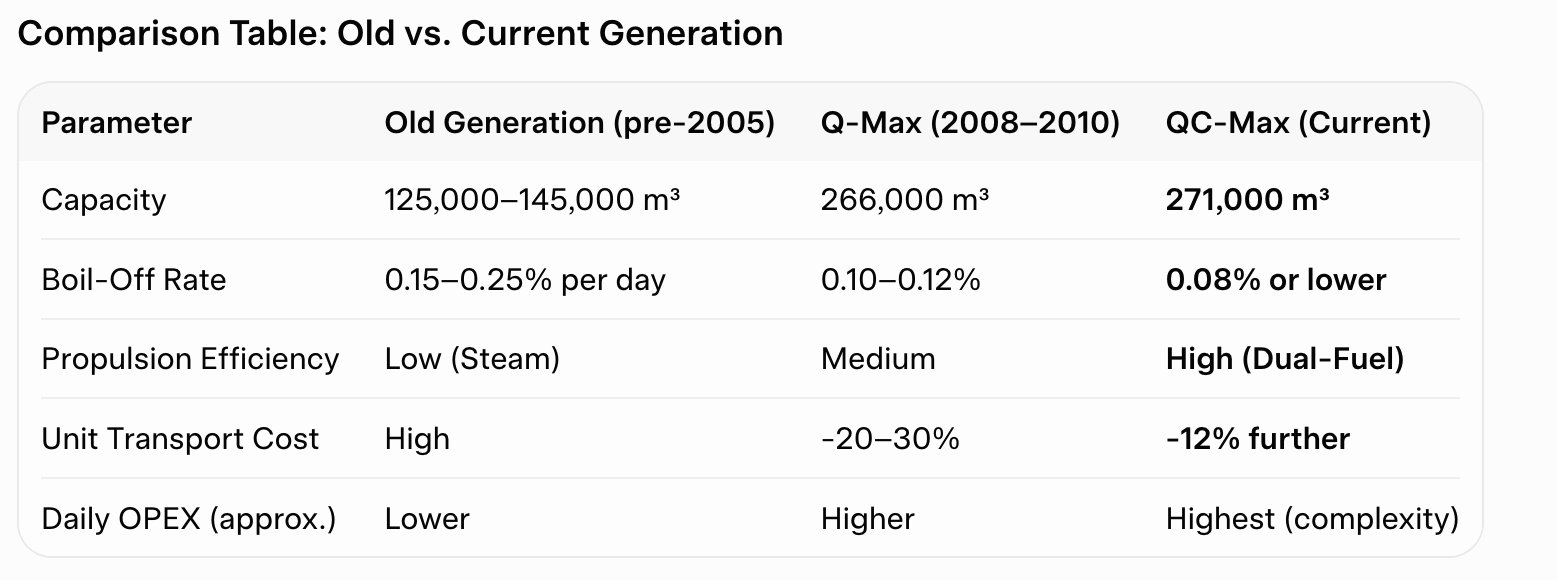
While capacity and basic efficiency have improved dramatically, the core problems of boil-off losses and high OPEX remain only partially solved. Even the best current QC-Max vessels still lose millions of dollars per year in evaporated cargo and face rising regulatory pressure on methane emissions.
This sets the stage for the next leap: a true next-generation design that finally tackles these weaknesses head-on.
The Cyber LNG Vessel – The Future Solution
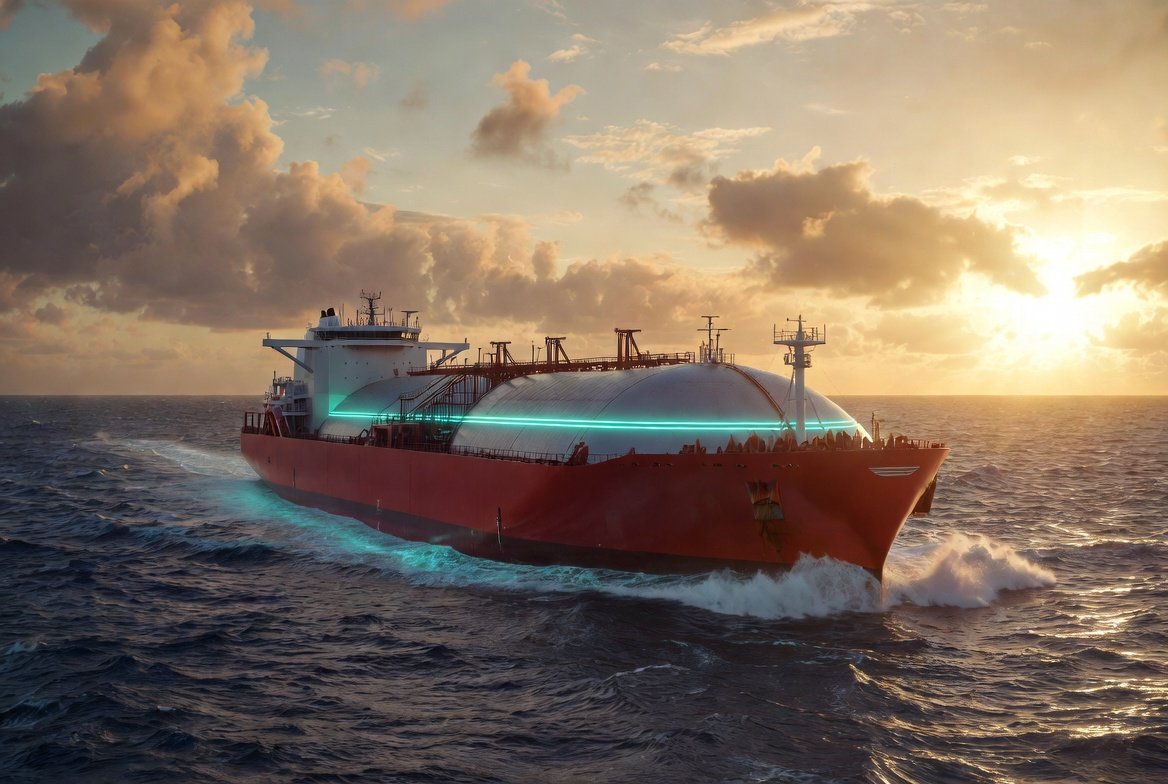
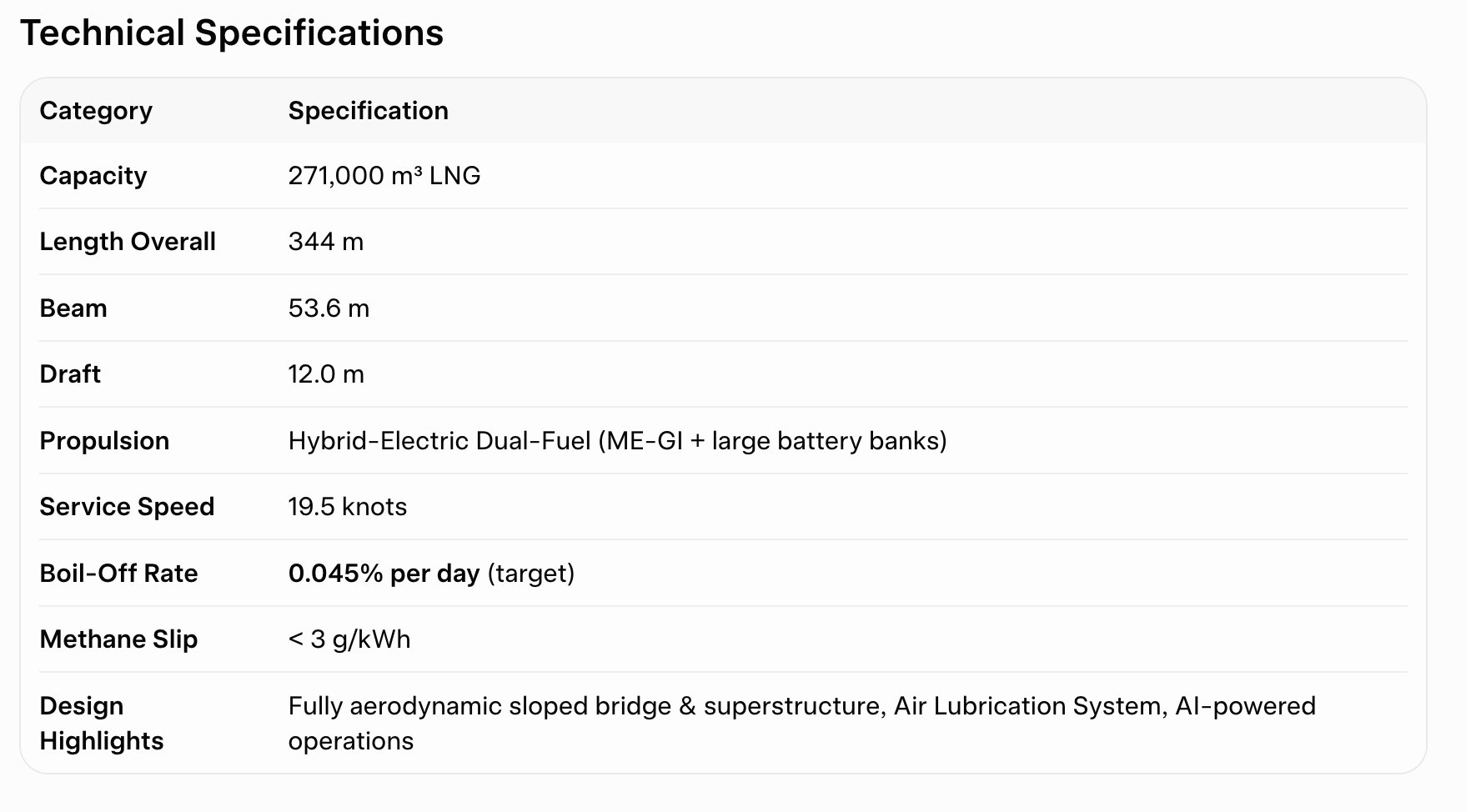
After decades of incremental improvements, the LNG shipping industry is finally ready for a genuine technological leap. Enter the Cyber LNG Vessel — a next-generation 271,000 m³ LNG carrier specifically engineered to solve the two most expensive weaknesses of today’s fleet: Boil-Off Gas losses and excessive operating costs.
Designed as an evolution of the powerful QC-Max class, the Cyber LNG Vessel combines proven scale with cutting-edge innovations in propulsion, insulation, aerodynamics, and digital intelligence.
Game-Changing Improvements
1. Revolutionary Boil-Off Management The biggest profit killer is finally brought under control:
- Advanced multi-layer vacuum insulation combined with next-generation membrane tank technology.
- AI-controlled, ultra-efficient reliquefaction plant that uses significantly less power than current systems.
- Result: Boil-Off Rate reduced from 0.08–0.10% (current best QC-Max) to 0.045% per day — a 55% reduction.
- Financial Impact: Saves approximately $9,000 – $15,000 per day in lost cargo value, or $3.3 – $5.5 million per year per vessel.
2. Next-Level Efficiency & Cost Reduction
- Hybrid-Electric propulsion with substantial battery storage allows optimized engine loading and peak shaving.
- Dramatically improved aerodynamics through a low-profile, heavily sloped “cyber” bridge and streamlined superstructure — reducing wind resistance by an estimated 18–22%.
- Air Lubrication System + optimized hull form for lower hydrodynamic drag.
- Overall Result: 14–18% lower total energy consumption compared to today’s best QC-Max vessels.
3. Cyber & Digital Intelligence
- Real-time Digital Twin of the entire vessel for predictive maintenance and optimized voyage planning.
- Autonomous cargo and ballast management systems.
- Drone landing platforms and advanced sensor arrays for continuous hull and tank monitoring.
- Modular design prepared for future conversion to ammonia or methanol as fuel.
The Bottom Line
While current QC-Max vessels already represent the best of today’s technology, the Cyber LNG Vessel delivers a decisive leap forward. It doesn’t just carry more LNG — it delivers more LNG to the destination by minimizing losses and slashes operating costs in an era of tightening environmental regulations and volatile energy prices.
This is not science fiction. The technologies required — improved insulation, hybrid propulsion, advanced aerodynamics, and AI control — are either already available or in advanced testing. The Cyber LNG Vessel represents the logical next step for forward-thinking operators who want to dominate the next decade of LNG shipping.
Why the Cyber LNG Vessel Changes the Game
The Cyber LNG Vessel is not just an incremental upgrade — it is a fundamental shift that addresses the biggest financial and operational pain points in modern LNG shipping, delivering superior returns in an increasingly competitive and regulated market.
Massive Financial Impact
The numbers speak for themselves:
- Boil-Off Savings: By cutting the daily boil-off rate to 0.045%, the Cyber LNG Vessel saves between $3.3 million and $5.5 million per year in preserved cargo compared to today’s best QC-Max vessels. Over a 25-year economic life, this represents $80–130 million in additional revenue per ship.
- Operating Cost Reduction: Thanks to hybrid-electric propulsion, aerodynamic design, and optimized energy management, total OPEX is projected to drop by 14–18%. On a daily basis, this can mean savings of $2,000 – $3,500 per day, or roughly $700,000 – $1.2 million annually.
- Combined Effect: The Cyber LNG Vessel is expected to generate $4.5 – $7 million higher annual EBITDA per ship compared to a standard QC-Max. With a newbuilding price premium of only 12–15%, the payback period for the additional investment is under 3 years.
Environmental Leadership
- Methane emissions reduced to < 3 g/kWh — well below upcoming EU FuelEU Maritime and IMO targets.
- Significantly lower CO₂ intensity due to hybrid operation and reduced fuel consumption.
- Better positioning for carbon taxes and green financing — vessels with superior environmental performance are already attracting lower interest rates and preferred long-term charters from ESG-focused buyers in Europe and Asia.
Strategic and Geopolitical Relevance
In a world where LNG trade is booming (global volumes expected to reach 650–700 million tonnes per annum by 2030), efficiency becomes a decisive competitive advantage:
- Lower unit transportation costs allow operators to win more flexible spot and medium-term contracts — especially important as U.S. volumes grow and compete with Qatar on price.
- Reduced dependency on perfect weather and routing conditions thanks to better boil-off control.
- Future-proof design: The modular architecture makes conversion to ammonia or methanol relatively straightforward when those markets mature.
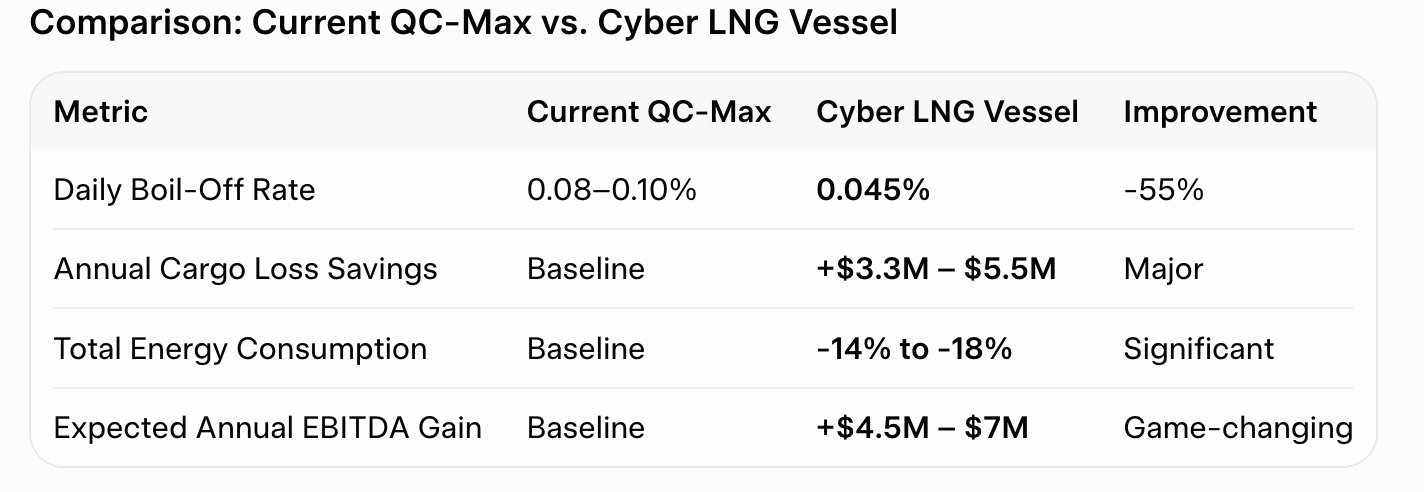
The Cyber LNG Vessel transforms LNG shipping from a high-risk, high-loss business into a highly optimized, future-ready profit center.
The Future of LNG Shipping – A New Era Begins
The global LNG industry stands at a historic inflection point. From the groundbreaking discovery of Qatar’s North Field in 1971 to the United States becoming the world’s top exporter in 2025, LNG has evolved into one of the most critical fuels of the energy transition. Global trade volumes are projected to exceed 650–700 million tonnes per annum by 2030, driven by Asia’s insatiable demand and Europe’s need for energy security.
Yet for too long, the maritime link — the ships that actually move this valuable cargo — has lagged behind. Even the impressive QC-Max class vessels, while revolutionary in scale, still suffer from costly boil-off losses and high operating expenses that erode margins and limit flexibility in a volatile, competitive market.
The Cyber LNG Vessel represents the necessary leap forward.
By slashing the daily boil-off rate to 0.045%, implementing hybrid-electric propulsion, and introducing radical aerodynamic design, this next-generation 271,000 m³ carrier directly attacks the two biggest financial drains in LNG shipping. The projected results are compelling:
- $80–130 million additional lifetime cargo value preserved per vessel
- 14–18% lower energy consumption
- $4.5–7 million higher annual EBITDA
- Substantially lower methane emissions and better regulatory compliance
This is more than an engineering achievement — it is a strategic and commercial advantage. In an era where every tonne and every dollar counts, operators equipped with Cyber LNG Vessels will enjoy lower unit costs, greater route flexibility, stronger charter attractiveness, and superior environmental credentials.
The transition from traditional LNG carriers to highly intelligent, ultra-efficient vessels like the Cyber LNG Vessel mirrors the industry’s own journey: from a desert discovery in Qatar, through America’s shale-powered surge, to a future defined by technology and efficiency.
The ships of tomorrow are not just carriers of liquefied gas — they are floating high-tech assets that maximize value from every molecule.
The question is no longer whether the industry needs this evolution. The question is: Who will build and operate the first fleet of Cyber LNG Vessels — and lead the next chapter of the global LNG story?
Follow & Read More
Read more powerful stories at GlobalBoats.World.
If you would like more articles on specific topics, have questions about the Mark V, or want to share your feedback, please visit our feedback page: GlobalBoat Feedback
We’d love to hear from you.