








How AI is Influencing Professional Tuna Fishing in 2026 – Real Facts & Current Impact
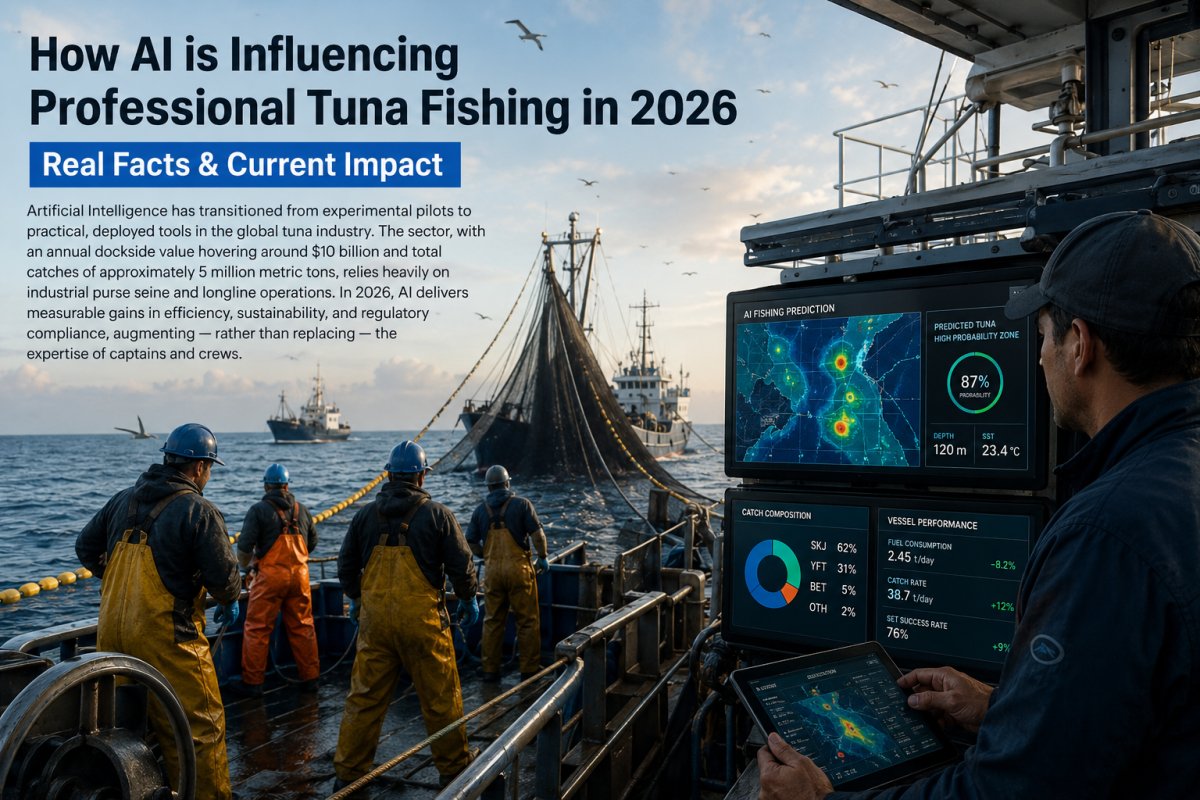
Artificial Intelligence has transitioned from experimental pilots to practical, deployed tools in the global tuna industry. The sector, with an annual dockside value hovering around $10 billion and total catches of approximately 5 million metric tons, relies heavily on industrial purse seine and longline operations. These methods dominate global production. In 2026, AI delivers measurable gains in efficiency, sustainability, and regulatory compliance, augmenting — rather than replacing — the expertise of captains and crews.
1. Smarter Fish Aggregating Devices (FADs) and Biomass Estimation
Drifting Fish Aggregating Devices (dFADs) equipped with echo-sounders serve as foundational tools for modern tuna purse seiners. The breakthrough comes from TUN-AI, developed through a partnership between Satlink and Komorebi AI, with collaboration from Spanish universities.
TUN-AI applies machine learning to raw echo-sounder data, incorporating oceanographic context such as currents, temperature, and chlorophyll levels. It achieves over 92% accuracy in detecting the presence or absence of tuna aggregations above a 10-ton threshold. For biomass quantification, it delivers estimates with an average relative error of around 28% — comparable to expert human analysts. This system has been validated across more than 15,000 buoys in the Atlantic, Indian, and Pacific Oceans.
Captains no longer chase every buoy in their network. They receive data-driven recommendations on which aggregations justify a visit, directly cutting fuel consumption, reducing empty net sets, and lowering operational costs. This selective approach also decreases pressure on ocean ecosystems by minimizing unnecessary searching.
2. Electronic Monitoring (EM) and the Fight Against IUU Fishing
Longline fisheries, often operating far from shore with limited observer coverage (frequently under 5%), present major transparency challenges. AI is closing this gap through Edge AI systems pioneered by The Nature Conservancy (TNC) in collaboration with partners like Tryolabs.
These onboard systems use compact, high-powered processors (such as NVIDIA Jetson devices) to analyze video footage in near real-time. They identify species, count catch, track bycatch or discards, and flag potential illegal, unreported, or unregulated (IUU) activities. Deployed in trials across the Eastern Tropical Pacific, with expansions planned for fleets like Palau’s in 2026, Edge AI processes data directly on the vessel. This eliminates delays of weeks or months associated with shore-based review.
Complementing this is CatchVision from Ai.Fish, an AI/ML platform that slashes manual EM footage review time by up to 80%. It automatically detects, counts, and classifies fish while highlighting events for human verification. This hybrid “AI-assisted review” maintains accuracy while dramatically reducing labor and costs for both operators and regulators.
The impact extends beyond compliance. Better bycatch data helps fleets avoid protected species and supports science-based quota management.
3. Predictive Analytics and Route Optimization
TunaTech by Zunibal exemplifies the next layer of intelligence. This system integrates AI with satellite data, real-time oceanographic variables (sea surface temperature, salinity, currents), historical catch patterns, and buoy telemetry.
Key capabilities include:
- Predicting likely tuna school locations and probable species composition.
- Real-time vessel route optimization.
- Forecasting FAD buoy drift trajectories up to 7 days in advance.
- Generating “hot tuna points” — high-probability fishing zones for both FAD-associated and free-school fishing.
Operators report improved tons-per-nautical-mile efficiency, lower fuel burn, and reduced bycatch of non-target species. Zunibal’s AI-enhanced software also incorporates triple-frequency transducers in buoys, enabling better discrimination between tuna species such as skipjack, yellowfin, and bigeye. This species-level insight supports more selective and sustainable harvesting.
4. Aquaculture Integration and Quality Assessment
AI’s influence reaches beyond wild capture. In tuna ranching and aquaculture operations, stereovision underwater cameras paired with computer vision models accurately count and size fish during transfers to cages. This reduces handling stress and improves inventory precision.
On the market side, Japanese buyers and processors increasingly use AI for quality grading based on images and sensor data, enabling better pricing for premium sashimi-grade tuna and supporting traceability from ocean to plate.
AreaAI BenefitReal ResultFuel & EfficiencyPredictive zones & route optimizationSignificant reduction in search time and fuel useSustainabilityBetter bycatch detection & species IDLower unwanted catch and ecosystem pressureComplianceOnboard video analysisUp to 80% less manual review; stronger IUU deterrenceBiomass EstimationTUN-AI on FAD buoys92%+ accuracy in aggregation detectionMarket ValueQuality & traceability assessmentBetter pricing and access to premium markets
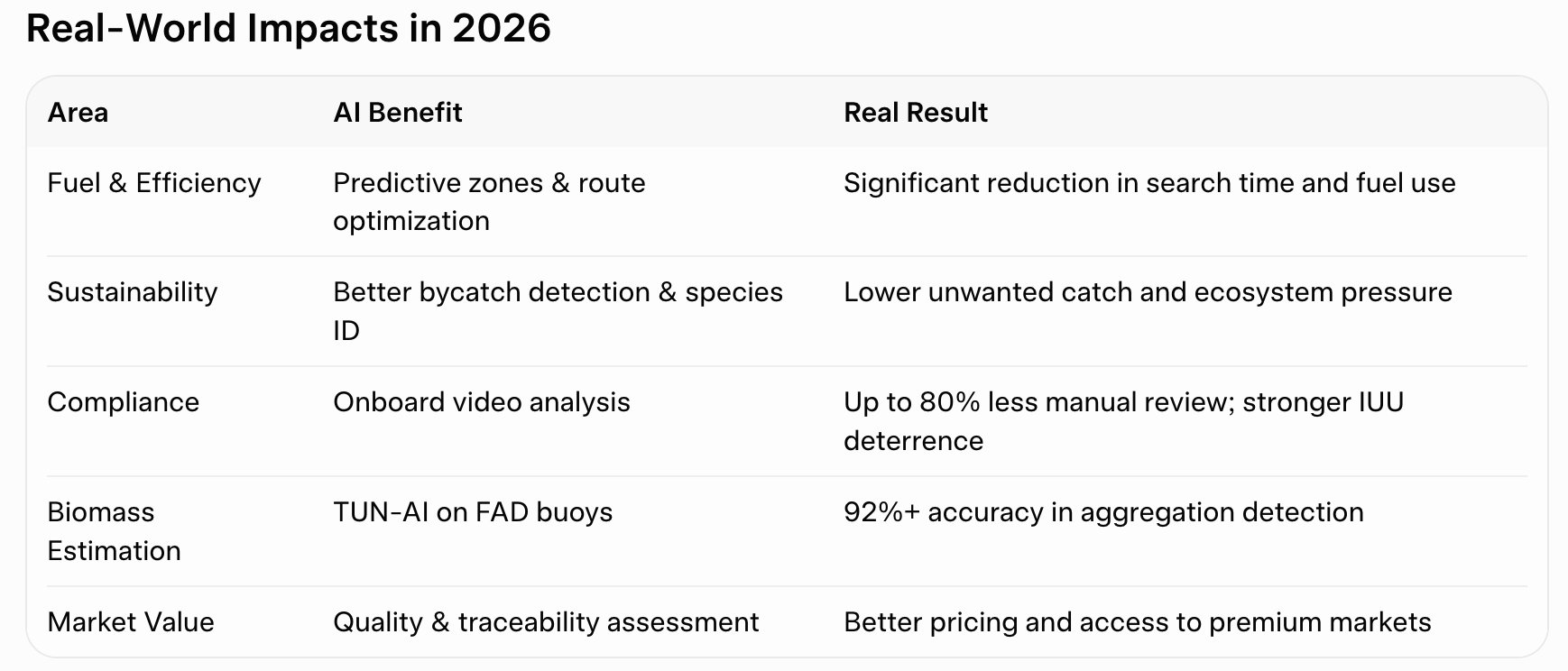
These gains accumulate. A single large purse seiner can save tens of thousands of dollars per trip in fuel while landing more consistent catches. For longliners, real-time insights improve safety and decision-making at sea.
Limitations and Honest Realities
AI adoption remains strongest in industrial fleets. Large vessels with substantial budgets can absorb the upfront costs of buoys, cameras, edge computers, and software subscriptions. Small-scale and artisanal fishers, who form a meaningful part of many coastal economies, lag due to cost, connectivity, and technical support barriers.
No system is perfect. TUN-AI’s 28% biomass error margin, Edge AI’s occasional misclassifications (especially between similar species like yellowfin and bigeye), and predictive models’ dependence on quality input data all require human oversight and ongoing calibration with actual catch records.
Regulatory pressure, NGO initiatives (such as TNC’s Tuna Transparency Pledge aiming for 100% monitoring by 2027), and demands from major buyers drive much of the progress. This top-down push sometimes creates tension with operators concerned about costs and data privacy.
The Human Element Endures
In 2026, the image of a tuna captain remains one of weathered experience, intimate knowledge of currents, bird behavior, and seasonal patterns. AI does not erase that. Instead, it acts as a powerful co-pilot — providing superhuman data processing while leaving final decisions to humans.
The best operators blend traditional seamanship with these tools. They interpret AI recommendations through the lens of local conditions, weather fronts, and fleet movements that algorithms might miss.
Looking ahead, further integration of multimodal data (satellite, drones, advanced sonar, and potentially autonomous surface vehicles) promises even tighter loops between prediction, action, and feedback. Blockchain for immutable traceability and expanded open-source AI models could accelerate benefits to smaller operators.
Bottom Line
Professional tuna fishing in 2026 is more data-driven, efficient, and scrutinized than ever. AI helps reduce waste, enhance sustainability, and meet stringent market and regulatory demands in a highly competitive, heavily managed industry. It is not a silver bullet for all challenges — overfishing risks, climate-driven stock shifts, and economic pressures persist — but it equips responsible operators with meaningful advantages.
For an industry often portrayed as traditional or even archaic, the quiet integration of AI represents a profound evolution. Fishermen are gaining superpowers: the ability to see beneath the waves with greater clarity, navigate vast oceans with precision, and document their operations with unprecedented transparency.
The ocean remains unpredictable, but those who intelligently combine human intuition with artificial intelligence are best positioned to thrive sustainably.