








What Anduril Arsenal-1 Can Teach the Yacht Industry About the Future of Manufacturing
The Uncomfortable Truth About Automation
The yacht and boat building industry has achieved remarkable things.
Over the past decades, serial manufacturers have industrialized production to an impressive level. Thousands of boats leave factories every year, designs have become more sophisticated, material quality has improved significantly, and brands have turned boat building into a global business with strong brands and loyal customers.
Companies like Beneteau, Brunswick, Bavaria, and Azimut-Benetti have scaled production volumes that would have been unthinkable 30 years ago. Modern shipyards use CNC machines, vacuum infusion, and advanced project management systems. In many ways, the industry deserves respect for what it has accomplished.
But behind the impressive numbers and shiny new models lies a more nuanced reality.
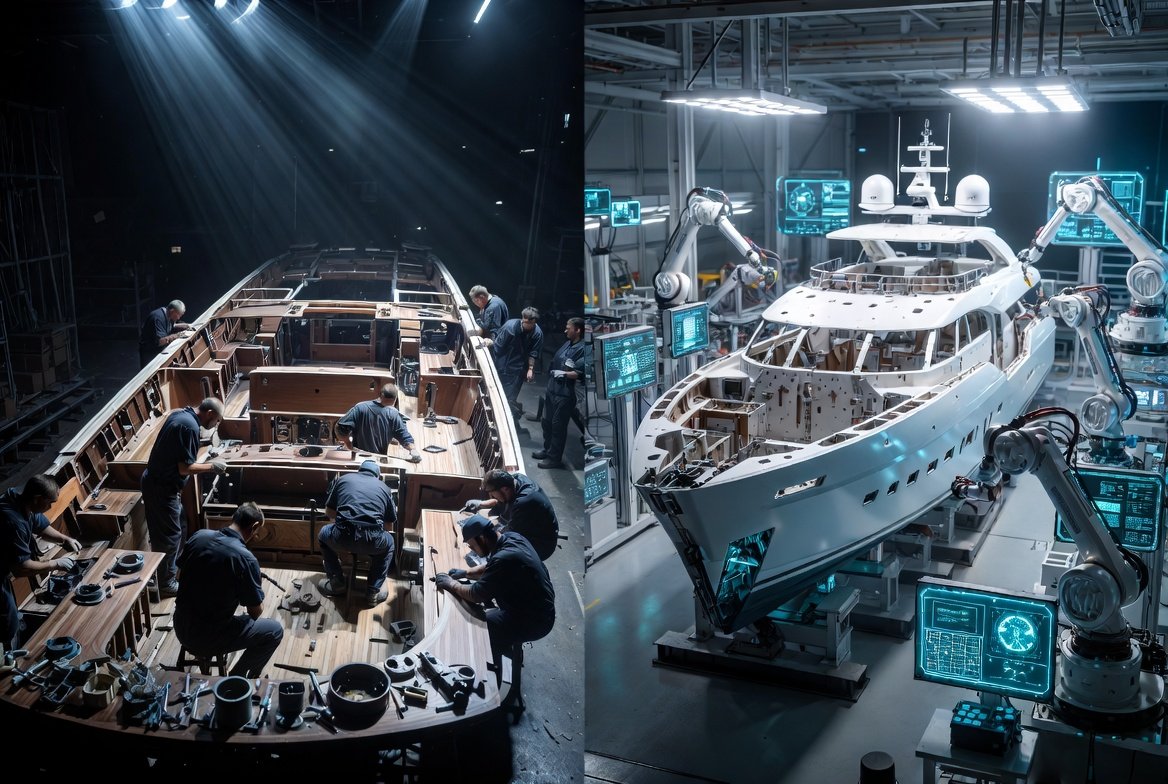
Even the most successful serial producers still rely heavily on manual labor in many critical areas. Lead times remain long, labor costs are high, and the ability to scale quickly during boom periods or react flexibly to market changes is still limited.
How big is the difference between the biggest players really?
Here is a clear, data-based overview of the 30 largest yacht and boat manufacturers by estimated annual production volume (2025/2026):
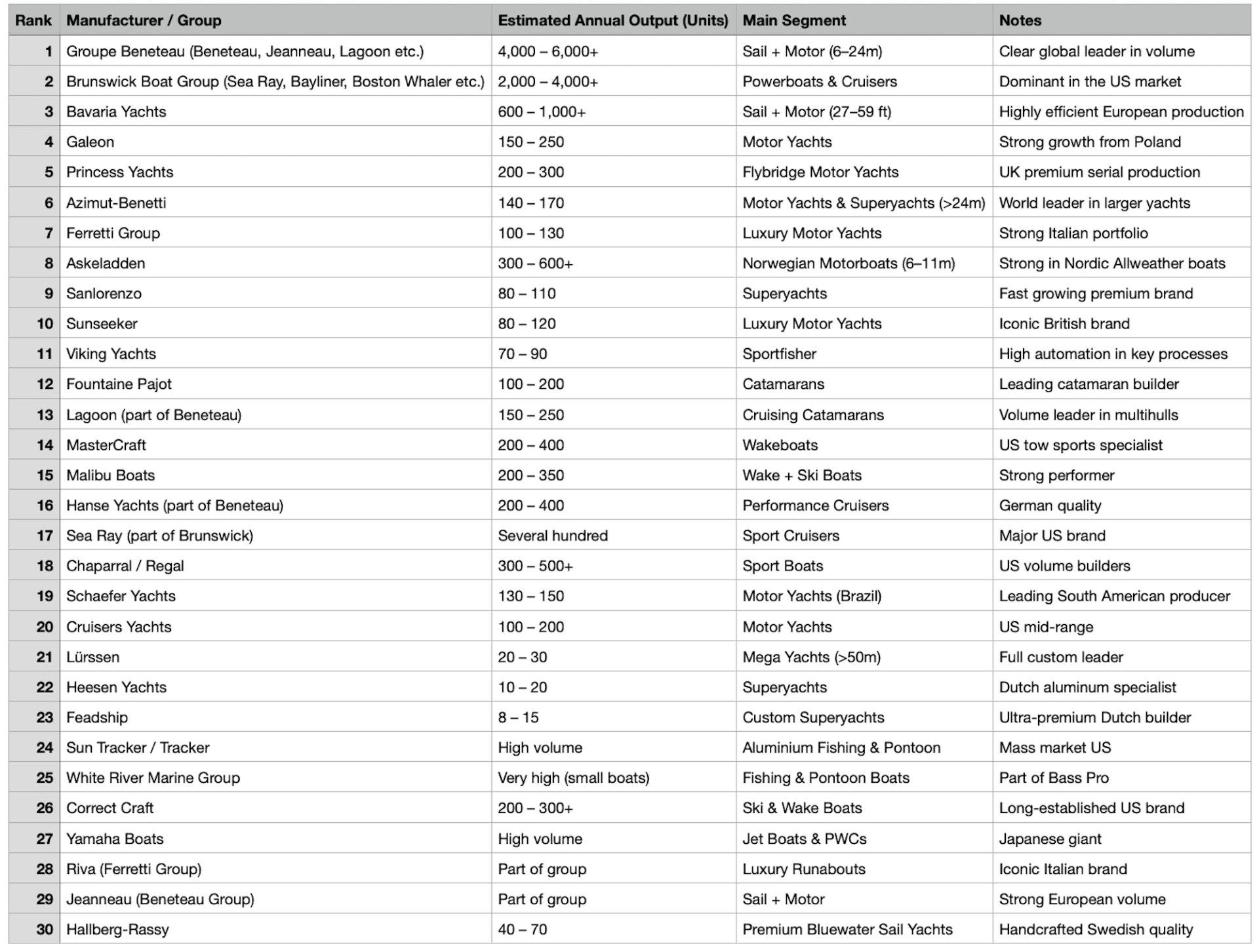
Interpretation of the Numbers – What Do They Really Tell Us?
Looking at the table above, a few clear patterns emerge:
- The Volume Kings are in a league of their own. Groupe Beneteau and Brunswick Boat Group produce thousands of boats per year. They have successfully industrialized large parts of the process and turned boat building into a real volume business.
- Strong Mid-Field Performers like Bavaria Yachts, Galeon, Askeladden, and Princess show solid output with several hundred units annually. Bavaria in particular stands out for its high level of automation in cabinetry and CNC production.
- Premium and Superyacht Builders operate on a completely different scale. Companies like Azimut-Benetti, Sanlorenzo, Lürssen, and Hallberg-Rassy produce between 10 and 170 units per year. Here, exclusivity, customization, and handcraftsmanship remain the main selling points.
- Even among serial producers, the gap between the absolute top (Beneteau/Brunswick) and the rest is enormous. The difference between rank 1 and rank 10 is multiple thousands of boats per year.
Key Takeaways:
- Higher production volume clearly correlates with higher automation investment. The biggest players can afford advanced CNC systems, lean manufacturing, and digital tools.
- However, even the most industrialized builders still depend heavily on manual labor for interior finishing, assembly, and quality control.
- The industry has made significant progress — but it remains far behind other manufacturing sectors (automotive, electronics, or aerospace) in terms of true scalability and automation depth.
This raises an important question:
Is the current level of industrialization enough for the future?
With rising labor costs, skilled worker shortages, volatile markets, and increasing pressure on delivery times, many experts believe the yacht and boat industry needs a bigger leap forward — not just incremental improvements.
The Critical Question: Is This Good Enough?
The numbers above show an industry that has come a long way — but also one that is reaching its limits.
The biggest serial manufacturers (Beneteau, Brunswick, Bavaria) have achieved impressive scale. They produce modern, high-quality boats in much higher quantities than ever before. However, even they still face the same structural problems year after year:
- Long production lead times (often 6–18 months)
- High dependency on skilled manual labor
- Difficulties scaling up quickly during market booms
- Rising labor costs and increasing challenges in finding qualified workers
- Limited flexibility when switching between models
Premium brands like Hallberg-Rassy and Feadship proudly embrace handcraftsmanship — and that is a valid strategy for the ultra-luxury segment. But for the broader industry (especially boats between 8m and 25m), continuing with the same approach may become risky.
The market in 2025/2026 has already shown signs of slowdown. Customers expect faster delivery, better value, and more consistent quality. At the same time, competition from new players and alternative materials is growing.
This leads us to the central question:
Can the yacht and boat industry afford to keep evolving at its current pace — or does it need a fundamental change in how boats are designed and manufactured?
l yacht building could hardly be bigger.
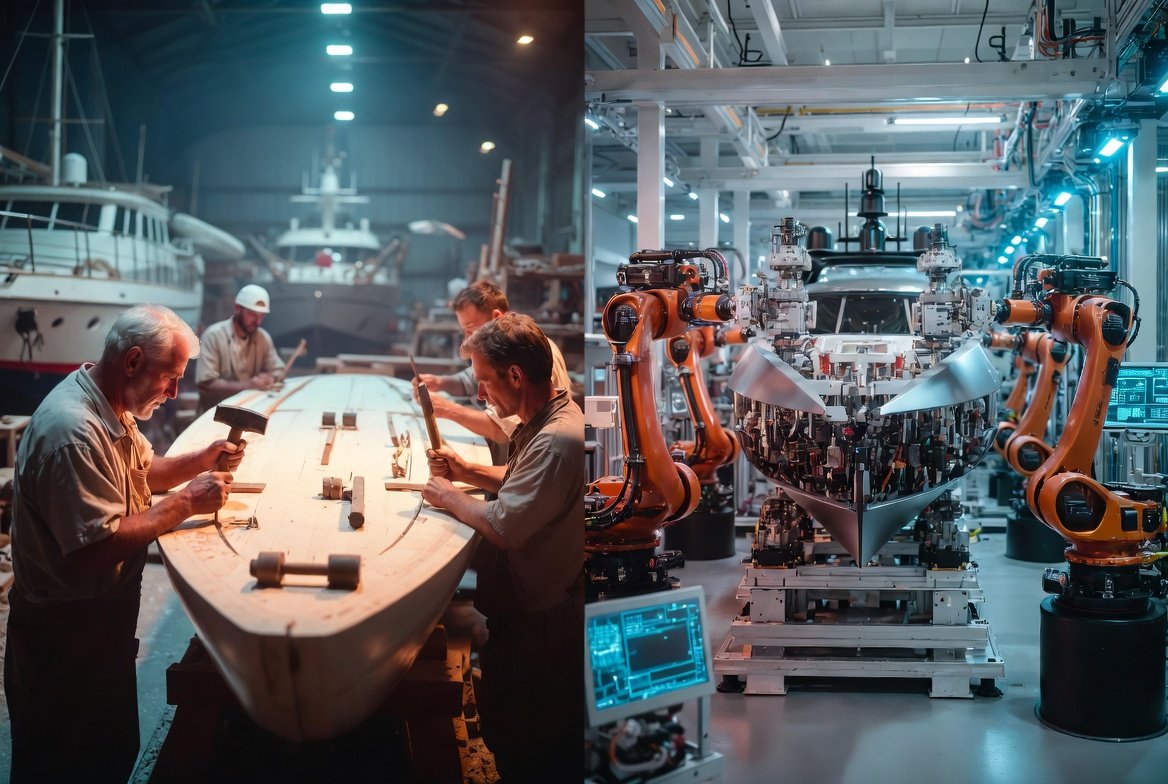
A New Benchmark: What Anduril Arsenal-1 Is Doing Differently
While the traditional boat industry continues to optimize existing methods, a completely different approach is being demonstrated in Ohio, USA.
- Anduril Industries originally known for advanced defense technology — has built Arsenal-1, one of the most ambitious manufacturing facilities of the decade. This is not just another factory. It is a software-defined manufacturing platform designed to produce tens of thousands of highly complex autonomous systems per year.
The contrast to conventional yacht building could hardly be bigger.
What Makes Arsenal-1 Truly Different?- Software as the Core of Production Unlike traditional factories that rely primarily on hardware (CNC machines, robots, assembly lines), Arsenal-1 is built around Arsenal OS (powered by Anduril’s Lattice platform). This software integrates design, engineering, supply chain, production planning, quality control, and assembly in one digital system. Changes in design can be rapidly translated into production instructions without months of retooling.
- Extreme Modularity & Flexibility Products at Arsenal-1 are designed from the ground up to be modular. The factory uses “fungible space” — meaning production lines are not fixed monuments. Everything is movable, and the same space can be quickly reconfigured to build different products (drones, missiles, underwater vehicles, etc.). This is the opposite of many boat yards, where a specific model often locks the production flow for years.
- Hyperscale Ambition
- Size: Over 5 million square feet (approx. 465,000 m²) of manufacturing space.
- Target Output: Tens of thousands of autonomous systems per year.
- Investment: More than $900 million of private capital.
- Workforce Goal: Up to 4,000 direct jobs. Production of the Fury high-speed combat drone already began in early 2026 — three months ahead of schedule.
- Philosophy: Speed, Cost, and Scalability First
Anduril questions the traditional obsession with heavy upfront automation. Instead, they focus on:
- Using commercial off-the-shelf components where possible.
- Designing products for manufacturability from day one.
- Prioritizing rapid iteration and low tooling costs.
- Building a workforce that can be quickly trained and shifted between products.
- Real Leadership & Talent – The Anduril Difference

What truly sets Arsenal-1 apart is not just technology — it’s the leadership and culture.
At the helm is Palmer Luckey, the founder who built Oculus and sold it to Facebook, only to later create Anduril with a clear mission: to make America the most technologically dominant military power again. His style is reminiscent of Elon Musk — extremely ambitious, hands-on, and intolerant of bureaucracy.
This is not a classic defense contractor led by managers and lobbyists. Anduril is run by vision-driven founders and engineers who are deeply involved in both strategy and execution. They don’t just oversee — they lead from the front.
Key elements of their culture:
- Best Hiring Philosophy: Anduril aggressively recruits top talent from Tesla, SpaceX, Apple, Google, and the best engineering universities. They look for people who are not just smart, but who want to dominate and win.
- Extreme Ownership: Engineers and production leaders receive unusually high levels of responsibility and authority very early. There is little hierarchy — decisions are made fast.
- Vision + Passion First: Yes, they have major U.S. government contracts. But unlike traditional defense companies, Anduril is not primarily contract-driven. They are mission- and vision-driven. Almost all profits and energy are reinvested into R&D and building better technology faster.
- “We are in the arena” mentality: The leadership doesn’t sit in fancy offices far away from the factory. They are deeply embedded in the team and the mission. This creates a high-performance culture where people work with real passion and urgency.
This combination — elite talent, real leadership, and a burning desire to win — creates a completely different dynamic compared to traditional manufacturing companies, including most yacht builders, where decisions are often slow, risk-averse, and layered with bureaucracy.
What Yacht and Boat Producers Can Learn from Arsenal-1
The gap between traditional boat building and Anduril’s approach is not just about technology — it’s about mindset.
Yacht and boat manufacturers can draw several powerful lessons:
- Software-defined manufacturing can dramatically reduce planning time, eliminate costly errors, and create a true digital thread from initial design all the way to final delivery.
- Modular design (standardized hull platforms, plug-and-play interiors, and flexible deck systems) would allow much faster model updates, easier customization, and significantly lower production costs.
- Flexible, reconfigurable factories instead of rigid production lines would give manufacturers the agility to react quickly to market changes and fluctuating demand.
- Radical focus on manufacturability from day one — instead of designing beautiful boats and then figuring out how to build them — could cut lead times and labor hours by a substantial margin.
The yacht industry deserves respect. It has successfully scaled traditional craftsmanship into a global, multi-billion-dollar business. Brands like Beneteau, Bavaria, Azimut, and Hallberg-Rassy have achieved remarkable things with the tools and methods of the past decades.
But the world has moved on.
Arsenal-1 proves that it is possible to build highly complex, high-quality products at massive scale — faster, smarter, and more efficiently — when manufacturing is rethought from first principles with software, modularity, and speed at the core.
The question for the yacht industry in 2026 is no longer whether it needs to evolve. The question is how bold it is willing to become.
Those who embrace these principles early will not only reduce costs and lead times — they will redefine what is possible in marine manufacturing for the next 30 years.