








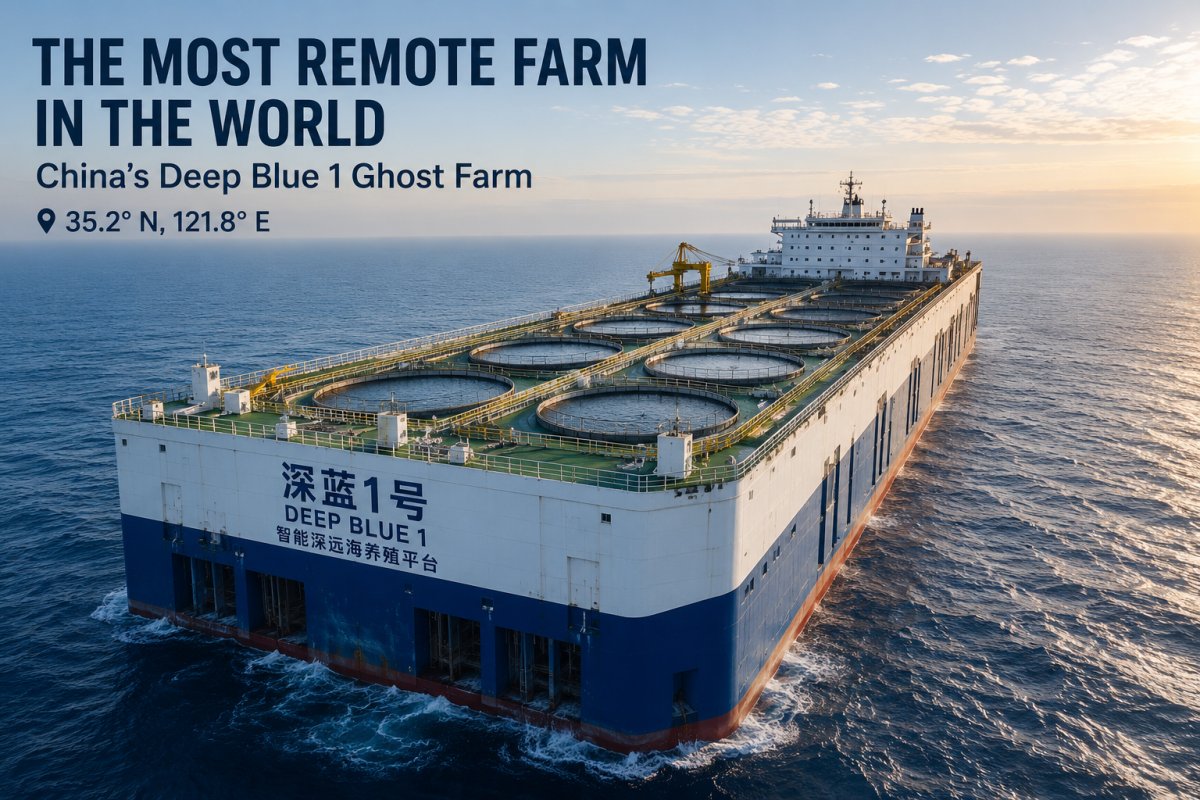
The Most Remote Farm in the World — China’s Deep Blue 1 Ghost Farm 📍 35.2° N, 121.8° E
Executive Summary
Offshore fish farming (open-ocean aquaculture) represents one of the most ambitious frontiers in marine food production. Operators are pushing further from shore to access cleaner water, stronger currents, and larger scale. Yet this expansion comes with a serious commercial and environmental shadow: abandoned “ghost farms” that continue polluting long after operations cease.
For commercial brokers, fleet operators, and investors who earn revenue daily in the marine sector, understanding both the upside of offshore farming and the costly legacy of abandoned sites is critical for risk management and opportunity spotting.
1. The Push into True Offshore Aquaculture
Modern offshore farms are engineered for extreme conditions:
- China’s Deep Blue 1 — Located over 100 nautical miles off the coast in the Yellow Sea, this massive octagonal structure can hold up to 300,000 Atlantic salmon.
- Norway’s Ocean Farm 1 — The pioneering semi-submersible farm, 110m wide and 68m high, capable of raising 1.5 million salmon in exposed waters.
- Panama’s Open Blue — One of the largest cobia operations, situated 12 km (≈7.5 miles) offshore in deep ocean waters.
These projects promise higher yields, better fish welfare, and reduced coastal conflict. However, the further offshore, the higher the operational risk — and the greater the potential cost of abandonment.
2. The Record: Most Remote Abandoned Offshore Fish Farm
While no official Guinness-style “world record” exists for the single most distant abandoned site, the farthest documented ghost farm operations are increasingly appearing in true offshore zones:
- China’s Yellow Sea projects have seen experimental structures pushed beyond 100 nautical miles. Some early large-scale cages have reportedly been left to degrade due to typhoon damage or economic viability issues.
- In the Gulf of Mexico, discussions around repurposing decommissioned oil platforms (e.g., Station Padre, ~25 miles offshore Texas) highlight both opportunity and risk — abandoned rigs-turned-farms could become the next generation of ghost infrastructure if projects fail.
- Newfoundland & Labrador (Canada) and remote Chilean Patagonia sites show abandoned gear drifting or sinking in increasingly exposed waters.
The practical “record” for problematic abandonment distance currently sits in the 50–100+ nautical mile range in high-value experimental zones (China, Norway exposed sites, and proposed US Gulf projects). These are far harder and more expensive to clean up than coastal Greek “ghost farms” (many abandoned for 20+ years in the Saronic and Ionian Seas).
Key Fact: Abandoned offshore infrastructure does not disappear. Nets, cages, polystyrene floats, and pipes continue ghost-fishing, releasing microplastics, and creating navigation hazards for years or decades.
3. Commercial Reality Check – Profit vs. Long-Term Liability
For Operators & Investors:
- Upside: Offshore sites can achieve superior growth rates and lower disease pressure due to better water exchange. Well-executed farms (e.g., Open Blue cobia) generate strong daily revenue.
- Downside: High capex + exposure to storms = elevated failure risk. When a farm fails financially or technically, removal costs can run into millions with no guaranteed responsible party.
- Regulatory Trend: Governments (Greece, Canada, Norway) are tightening rules, but enforcement in truly remote waters remains challenging.
For Brokers & Dealers:
- Prioritize listings of modern, compliant, high-spec vessels and support equipment for offshore operators.
- Verified GlobalBoats profiles that highlight experience in offshore logistics, maintenance, and decommissioning gain trust in this high-risk segment.
- Opportunity: Lead generation around refit, monitoring, and decommissioning services — the flip side of the offshore renaissance.
Risk Mitigation Playbook:
- Demand strong financial bonding and removal guarantees in contracts.
- Factor in end-of-life decommissioning costs (often 10–20%+ of project capex).
- Use structured data on GlobalBoats to track operator track records before partnering.
GlobalBoats Market Intelligence Perspective
Offshore fish farming will grow dramatically as wild stocks face pressure and coastal space becomes scarce. However, the industry’s credibility depends on solving the ghost farm problem. Professionals who combine innovation with rigorous responsibility (proper planning, verified partners, and transparent operations) will dominate.
The winners will treat decommissioning and environmental stewardship not as an afterthought, but as core business infrastructure.