


The Azores Today: A Mid-Atlantic Strategic Powerhouse – Military, Cables, Data, Trade & Tax
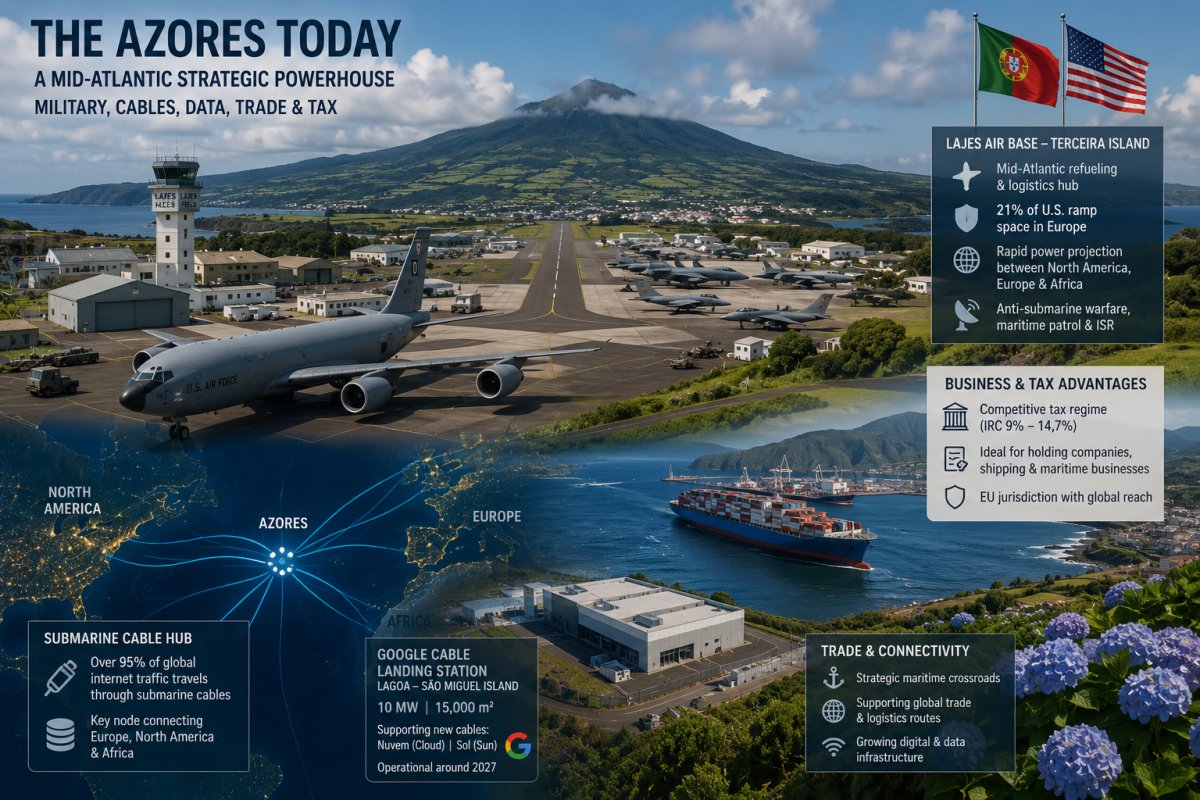
In 2026, the Azores remain one of the most strategically valuable pieces of real estate on the planet. Nine volcanic islands located roughly 1,500 km west of Lisbon sit at the crossroads of the North Atlantic, controlling critical air, sea, and digital routes between Europe, North America, and Africa. Their importance has not diminished since the age of sail — it has evolved.
Military Significance: NATO’s Unsung Atlantic Fortress
The Azores’ military value centers on Lajes Air Base on Terceira Island. Jointly operated by Portugal and the United States, it hosts the U.S. Air Force’s 65th Air Base Group. Despite reductions in permanent U.S. personnel over the past decade, the base retains high operational relevance.
In early 2026, amid U.S.-Israeli operations against Iran, Lajes saw its heaviest activity in years: dozens of KC-46 Pegasus tankers, F-16 Viper fighters, C-17 Globemaster, and C-5M Super Galaxy transports transited through the base. Portugal authorized over 76 landings and 25 overflights, with the explicit condition that the base not support strikes on civilian infrastructure.
Lajes provides:
- Mid-Atlantic refueling and logistics hub
- 21% of U.S. ramp space in Europe
- Rapid power projection between North America, Europe, and Africa
Its location makes it ideal for anti-submarine warfare, maritime patrol, and transatlantic air bridge operations. NATO and U.S. officials repeatedly describe it as “strategic” and “critical” in the renewed great-power competition in the Atlantic. Portugal maintains full sovereignty, granting access under bilateral agreements, which gives Lisbon significant leverage.
The Azores also serve as a forward base for monitoring submarine activity and protecting critical infrastructure — a role that has grown with increasing Russian and Chinese interest in Atlantic operations.
Submarine Cables: The Digital Lifeline
Over 95% of global internet traffic travels through submarine cables. The Azores sit directly on major transatlantic routes and have become a key node in this invisible network.
Google is heavily investing in the region. The company is building a 10 MW, 15,000 m² cable landing station and data facility in Lagoa (São Miguel Island) to support two major new cables:
- Nuvem (Cloud)
- Sol (Sun) — connecting the U.S., Bermuda, the Azores, and Spain
These projects, expected to be operational around 2027, will significantly increase bandwidth and redundancy across the Atlantic. The Azores interconnect all nine islands internally via systems like AFOS (Azores Fiber Optic System) and serve as a resilient mid-point hub.
This infrastructure is geopolitically sensitive. Subsea cables are vulnerable to sabotage, and major powers are racing to secure them. The Azores’ position makes them a natural “digital fortress” — or a high-value target.
AI Data Centers and Technological Ambition
Google’s investment signals growing interest in the Azores as a location for AI-related infrastructure. Cool Atlantic climate, renewable energy potential (wind and geothermal), political stability, and EU membership make the islands attractive for energy-intensive data centers.
The regional government actively promotes the Azores as a hub for high-performance computing and digital connectivity. Lower VAT rates (16% standard, down to 4% super-reduced) and specific incentives for tech investments support this vision. While not yet a major AI hub like Iceland or northern Sweden, the combination of Google’s cable projects and local policy creates a foundation for future growth.
Trade, Economy, and Tax Advantages
The Azores benefit from Outermost Region (OR) status under EU law (Article 349 TFEU), granting special fiscal and structural measures due to their remoteness, insularity, and economic dependence.
Key facts:
- Corporate Income Tax in the Azores is lower than mainland Portugal (around 16.8% vs. 21%).
- Reduced VAT rates: 16% standard, 9% reduced, 4% super-reduced.
- Specific tax credits and deductions for investments in priority sectors (tourism, renewable energy, technology, agriculture).
- Incentives for qualified professionals and companies under regional adaptations of Portugal’s tax regimes.
Economically, the region relies on tourism, agriculture (pineapples, dairy, wine), fisheries, and public administration. The new digital investments offer diversification. Trade flows benefit from the islands’ position on Atlantic shipping and air routes, though the economy remains relatively small (population ~250,000).
Sharp Analysis: Real Power vs. Limitations
Truth: The Azores are genuinely strategic in 2026. Their location gives Portugal disproportionate influence within NATO and the EU. The U.S. needs Lajes for flexible operations without full bases on the European mainland. Google’s investments show private-sector recognition of the islands’ digital value.
Truth: The islands are not a decisive “game changer” on their own. They are a supporting node — important for logistics, resilience, and monitoring, but not a primary theater of conflict. Permanent U.S. presence has shrunk, and Portugal carefully balances sovereignty with alliance commitments.
Truth: Tax advantages are real but limited. The Azores offer cost savings compared to mainland Europe, but they cannot compete with true offshore havens on pure tax minimization. Their strength lies in stability, EU access, and geographic position rather than aggressive tax engineering.
Truth: Climate and geography are double-edged. Volcanic terrain and remoteness raise infrastructure costs, but also provide natural cooling for data centers and renewable energy potential.
The Azores exemplify “strategic geography” in the 21st century: a place where military logistics, digital infrastructure, and economic policy converge. Portugal has successfully maintained sovereignty over these islands for nearly 600 years — a rare achievement. In today’s world of hybrid threats, undersea cable vulnerabilities, and AI-driven data demands, the Azores are more relevant than ever.
They are not just a historical curiosity or a tourist destination. They are a quiet but vital piece of Atlantic architecture — one that major powers continue to value, and that Portugal continues to control.